
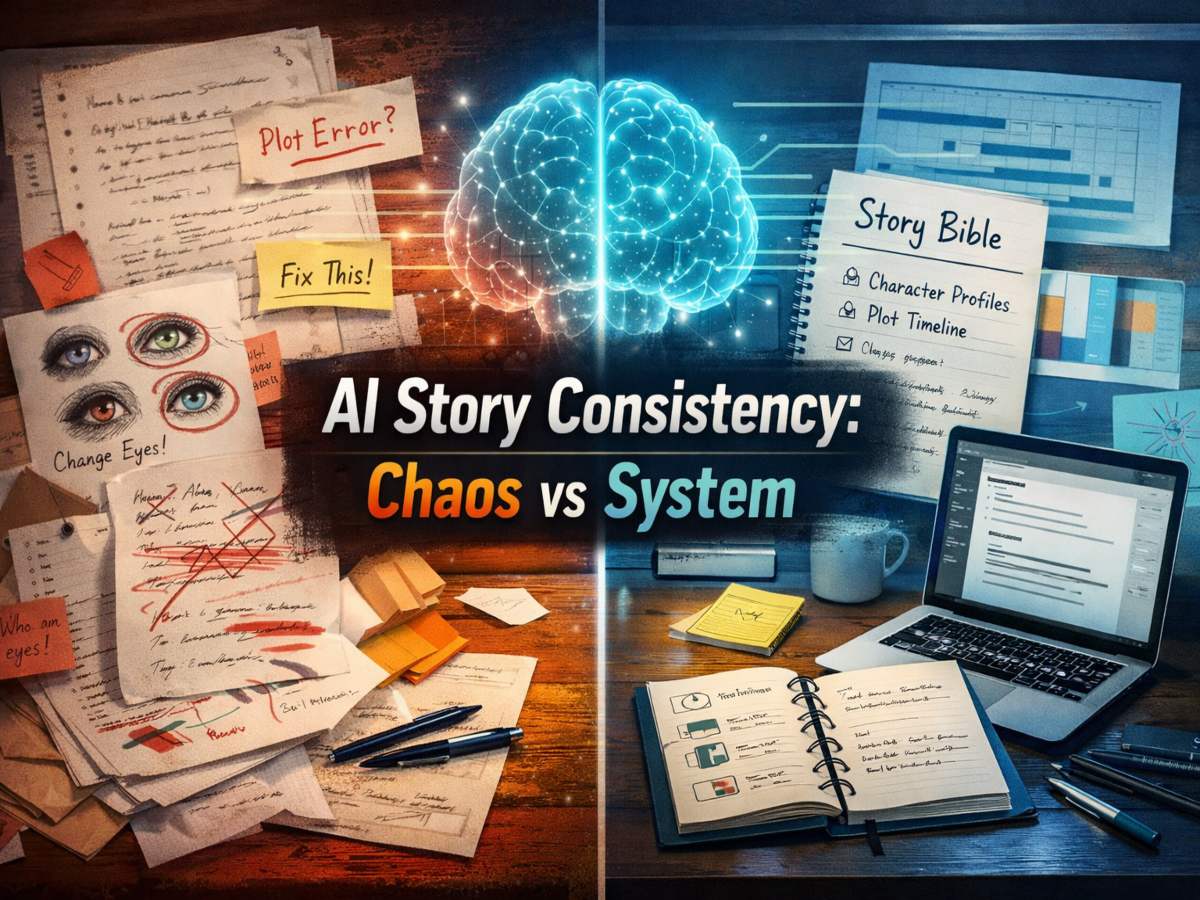
Here is the truth nobody tells you when you start writing with AI. The first chapter feels magical. Then the second chapter forgets your main character’s name. By chapter five, the whole story feels like it was written by five different people.
That is the AI story consistency problem in a nutshell.
I ran into this while writing a sci-fi novella with AI help.
- My main character changed eye color twice.
- His sarcasm disappeared completely.
- A weapon I introduced in chapter two vanished like it never existed.
- The creativity was there. The structure was not.
AI does not remember your story the way you do. It predicts text based on patterns and whatever fits inside its context window. Without a solid reference point, tone drifts, characters change, and maintaining plot coherence with AI turns into a constant battle.
But here is the good news. Once I built real systems around the AI, everything clicked. Improving AI storytelling is not about finding magic prompts. It is about workflows, guardrails, and smart iteration.
Quick Summary
- AI needs one clear source of truth to work from
- A story bible is your most powerful tool
- Generate content in smaller chunks, not giant dumps
- Refresh the AI’s context every thousand words or so
- Always do a separate pass just for tone and voice
When I started treating the AI like a collaborator instead of a ghostwriter, AI story consistency improved fast.
How to Make AI Writing Consistent
Build a Story Bible First
If you only take one thing from this article, let it be this. Build a story bible before you write a single chapter. Nothing stabilizes a long narrative faster than one authoritative document the AI can pull from. Without it, inconsistency creeps in quietly and ruins everything.
Lock Down Your Character Profiles
I call this “Identity DNA.” Before drafting, I write out each main character’s core traits, physical details, speech patterns, and emotional triggers. Things like:
- Core personality traits that never change
- Physical markers like scars, posture, or habits
- How they talk and what sets them off emotionally
- Their long-term goals and hidden fears
Strong AI character development depends on repetition. If you do not restate the defining traits, the model will improvise them.
Here is a real example. I described one character as quietly analytical. Three chapters later, without any reinforcement, he became loud and impulsive. That was not character growth. That was drift.
Write Down Your World-Building Rules
Settings need internal logic. If your world has unusual physics or magic with real limits, you need to document those rules. I keep a simple continuity table like this:
| Element | Rule | Must Stay Consistent? |
| City lighting | Neon and dim | Yes |
| Tech level | Pre-AI collapse | Yes |
| Transport | Magnetic rails | Yes |
This one habit alone cuts down on contradictions and keeps plot coherence with AI much more manageable.
Set Clear Tone and Voice Guidelines
Tone disappears faster than plot details. So I define it early with a few simple anchors:
- Three to five adjectives that describe the overall feel
- Clear point-of-view rules
- One anchor paragraph that captures the exact voice I want
Before every new section, I paste that anchor paragraph into the prompt. It protects AI writing flow and tone across chapters better than almost anything else I have tried.
Track Your Objects and Timeline
If a character drops a ring in chapter three, that ring does not magically appear in chapter five unless someone picks it up. Objects have to obey logic.
Tracking this feels tedious. But it protects AI story consistency more than any clever prompt ever will.
Use Tools Built for Fiction
Generic chat tools were not built for long narratives. They struggle with multi-chapter memory. Fiction-specific AI tools handle this much better.
Sudowrite has a built-in Story Bible feature that stores character details and world data across your whole project. I have used it to auto-reference traits between scenes, and it cuts down on memory loss significantly. You can check it out at sudowrite.com.
NovelAI uses a system called a Lorebook. When certain keywords show up in your story, stored character details trigger automatically. That mechanism dramatically improves AI story consistency in longer work. Visit novelai.net to learn more.
Squibler focuses on structure and organization. Its visual plot tracking lets you map out beats and tension curves so that improving AI storytelling becomes more systematic. Find it at squibler.io.
These tools do not replace discipline. They reinforce it.
Work Sequentially, Not All at Once
Trying to generate an entire novel in one go invites disaster. I have tried it. It collapses fast.
Generate in Smaller Chunks
Instead of asking for five thousand words, I generate six hundred to twelve hundred words at a time. Smaller segments give you tighter control over where the story goes.
Use Anchor Paragraphs Between Chapters
Before drafting a new chapter, I ask the AI to analyze a previous passage for tone and pacing. Then I tell it to match that pattern going forward. This small habit strengthens AI story consistency more than you might expect.
Summarize Progress Every Thousand Words
Context fades. So after every thousand to two thousand words, I write a quick manual summary that covers:
- Where each main character stands emotionally and physically
- What conflicts are still open
- What plot threads are waiting to be resolved
Then I paste that summary right into the next prompt. That one step drastically improves maintaining plot coherence with AI over long projects.
Draft First, Polish Later
Do not try to perfect tone while you are still drafting. It slows everything down. Separate creation from refinement. Build the structure first. Clean it up later.
Edit With Purpose
Drafts are messy. Editing is where the real work happens.
Do a Tone-Only Pass
During this pass, I ignore plot problems completely. I only look at:
- Sentence rhythm and flow
- Emotional consistency across scenes
- Whether the dialogue sounds like real people talking
This single pass does more for AI writing flow and tone than any amount of careful drafting.
Check Character Behavior Directly
Ask the AI a direct question. Something like: “Does this character behave consistently with how they acted in the earlier chapters?” The AI can self-audit surprisingly well when you prompt it carefully.
Scan for Logical Gaps
I also run a dedicated consistency scan where I ask for a list of contradictions in the text. You will be surprised how many small ones slip through. These AI story editing techniques turn rough drafts into stories that actually hold together.
Keep Visuals Consistent Too
If your story includes illustrations or AI-generated images, text consistency is not enough on its own.
Lock In a Reference Image
When generating art for a character, I upload a reference image and reuse it every time. Changing the visual prompt completely each session causes the character’s appearance to drift just like text does.
Modify Actions, Not the Whole Prompt
Instead of rewriting everything, I change only what is different. Something like: “Same character, now running.” That approach preserves the visual identity and supports overall AI story consistency across both text and images.
Conclusion
AI is genuinely great at improvisation. It is genuinely bad at memory. Once I stopped expecting it to remember everything on its own and started building real systems around it, the results improved right away. Structure creates reliability. Process beats prompt tricks every single time.
Improving AI storytelling takes discipline, iteration, and honest self-review. But here is the paradox. When you add the right constraints, creativity does not shrink. It actually sharpens. Constraints unlock coherence. That is the whole game.
FAQs
1. What is AI story consistency?
AI story consistency means keeping your characters, tone, and plot stable and free of contradictions across AI-generated chapters.
2. How do you make AI writing consistent across chapters?
Build a story bible, generate in smaller chunks, summarize progress regularly, and use structured AI story editing techniques during revision.
3. What are the best AI fiction writing tools for long stories?
Sudowrite, NovelAI, and Squibler all support long-form memory, character tracking, and plot organization far better than general chat tools.
4. How do you maintain plot coherence with AI?
Summarize prior events often, restate character motivations in each prompt, and catch contradictions during a dedicated editing pass.
5. Can AI maintain a consistent tone on its own?
Not reliably. You need to reinforce tone using anchor paragraphs and structured revisions to protect AI writing flow and tone throughout your manuscript.
Leave a Reply