

I didn’t fail my first novel because I was untalented—I failed because my brain couldn’t hold an entire book at once, and I kept forgetting what I’d written so characters shifted personalities, subplots vanished, and I rewrote the opening so many times I never reached the middle until months later I had tens of thousands of words that weren’t a novel but just disconnected scenes, which was when I realized the problem wasn’t effort but scale since writing a novel means juggling hundreds of moving parts inside one fragile human memory, and that’s when I discovered Best AI tools for novel writing could act as a second brain tracking story threads, maintaining consistency, and turning chaos into something publishable.
Here’s what changed: I stopped looking for a magic “write my novel” button and started building a system. Not with 23 different tools—just three that work together.
I’ll show you the workflow I used to write, edit, and structure a complete 92,000-word manuscript, and why most writers are using these tools wrong.
What Novel Writers Actually Need From AI Writing Tools
Let’s be honest. Most articles about professional AI writing tools focus on features nobody uses. They’ll tell you about grammar checking when you’re wrestling with plot structure. They’ll praise word count trackers when your protagonist just contradicted herself in chapter twelve.
Real novelists face different problems:
- Plot coherence matters more than perfect grammar. Your story needs to make sense from page one to page three hundred, with setups that pay off and mysteries that resolve. An AI that can’t track your plot threads across 80,000 words isn’t helping you write a novel—it’s just making prettier sentences.
- Character memory separates amateur tools from serious fiction software. When your character mentioned their fear of water in chapter three, your AI better remember that in chapter twenty-seven.
- Voice consistency challenges every novelist. Your hardboiled detective shouldn’t suddenly sound like a philosophy professor. The best fiction writing AI tool helps you maintain that distinctive narrative voice—not by writing for you, but by flagging when you drift off-key.
- Drafting speed versus quality creates tension. We all want to write faster. But speed without structure produces garbage that takes twice as long to revise.
I learned this the hard way. My first AI-assisted draft from a novel writing software had a character limping on alternating legs. Readers notice these things.
This separates useful AI from gimmicky tools that promise to write your novel while you sleep. You need a thinking partner, not a ghostwriter.
The Best AI Tools for Novel Writing (My 3-Tool Stack)
After testing everything from Jasper to ProWritingAid to obscure beta tools, I settled on three that work together:
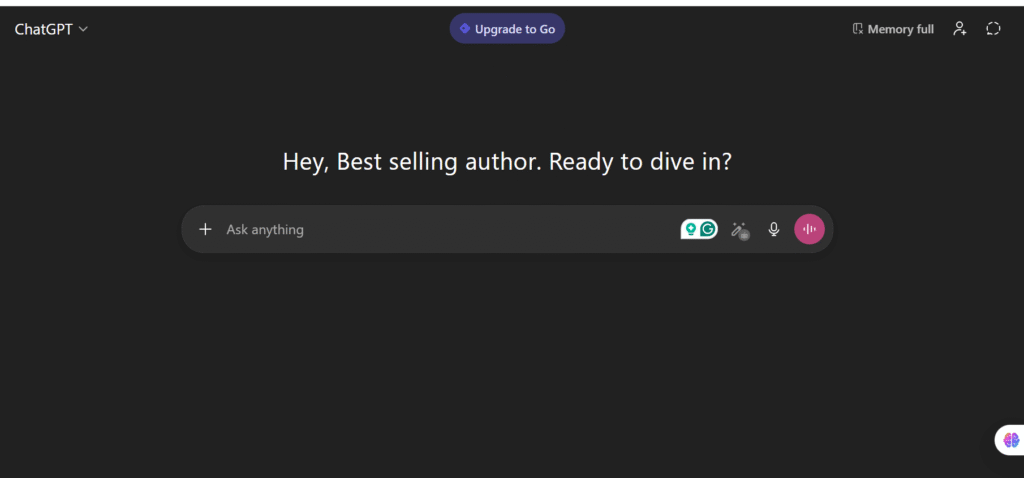
ChatGPT functions as my brain—the analytical planner that structures ideas, solves plot problems, and helps me think through character arcs. It excels at logic and creative problem-solving.
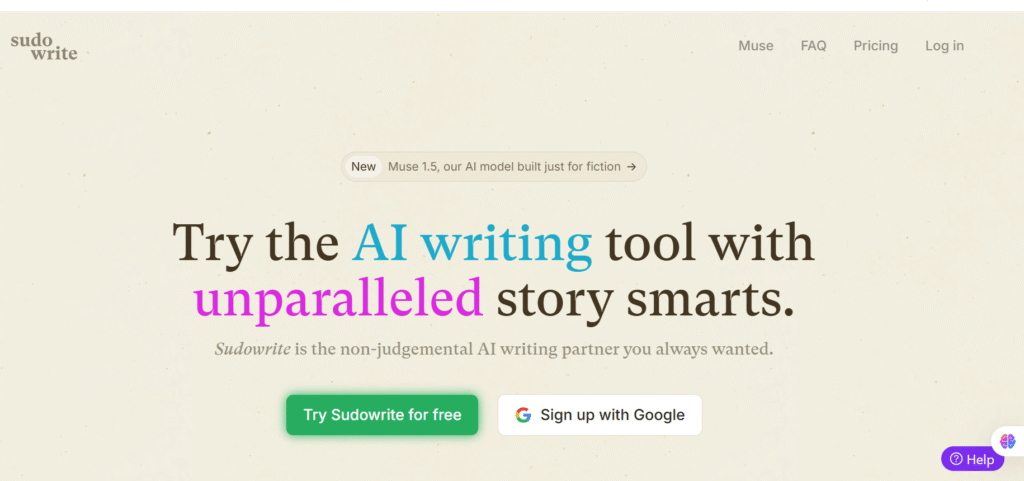
Sudowrite acts as my imagination—the creative engine that transforms “John walked into the dark room” into vivid prose with sensory details and emotional resonance. Where ChatGPT thinks, Sudowrite feels.
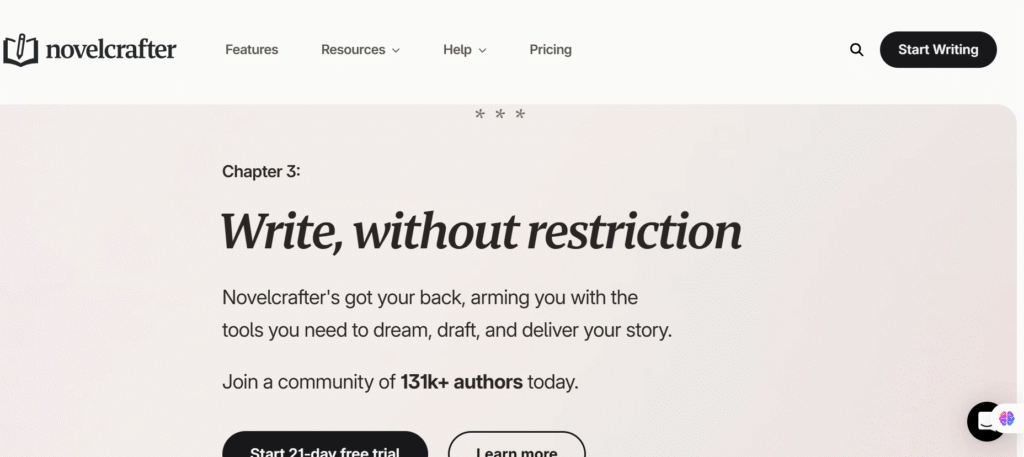
Novelcrafter serves as my control system—the organizational backbone that keeps 92,000 words from collapsing into chaos. It’s where everything comes together into an actual manuscript.
Most beginners make the mistake of picking ChatGPT and trying to force it to do everything. Or they grab Sudowrite and wonder why their plot doesn’t make sense. Professional authors understand specialization of combining top Ai novel software.
ChatGPT for Novel Writing and Story Planning (Reviewed and Tested)
I used ChatGPT to map 42 chapters before writing a single page. Sounds backward, right?
ChatGPT excels at structural thinking. Feed it your premise, and it’ll spot the logical gaps you missed. My thriller involved a missing person case, but ChatGPT helped me realize I’d never explained how the detective got jurisdiction. Small detail, huge plot hole.
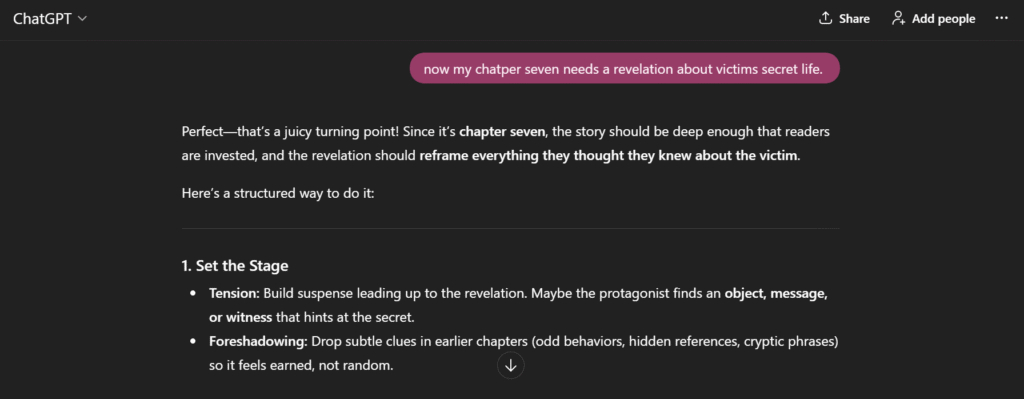
Plot design becomes collaborative. I’d sketch rough ideas: “Chapter seven needs a revelation about the victim’s secret life.” ChatGPT would suggest three different revelations, each with different story implications. Not writing the chapter for me—helping me think through possibilities.
Character backstories need consistency. ChatGPT helped me track that my protagonist grew up in Seattle (not Portland—I almost mixed it up), lost her mother at fourteen, and chose law enforcement after failing to protect her younger brother.
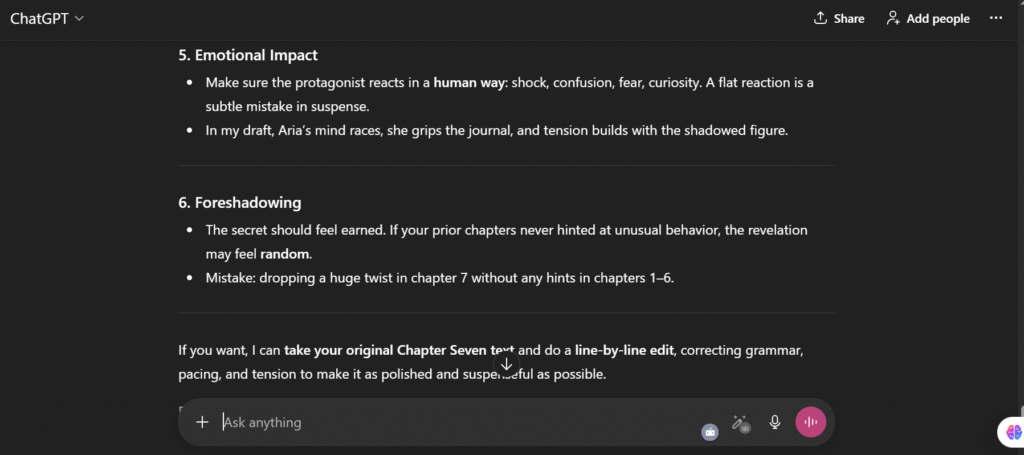
Scene logic matters more than beautiful prose. Before Sudowrite polished my writing, ChatGPT made sure the scenes actually made sense. Can the detective legally search that apartment? Would the witness realistically cooperate? Does the timeline work?
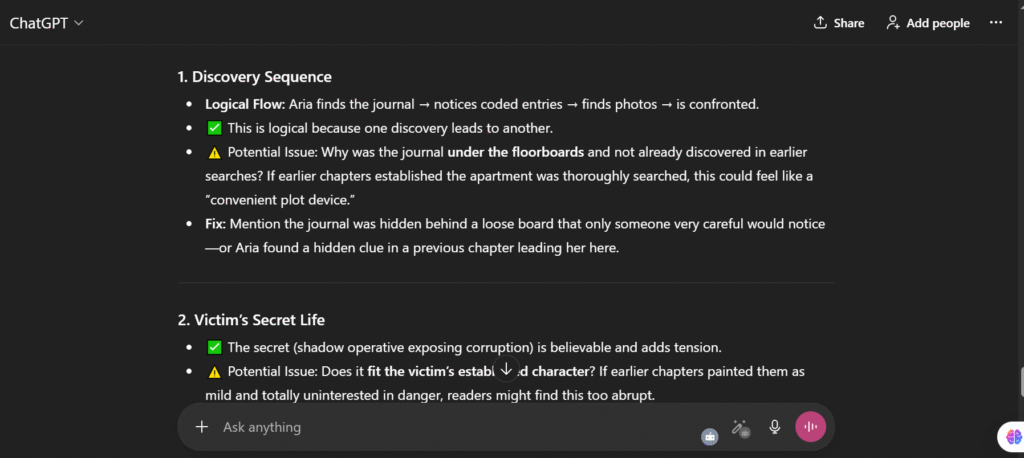
Every time I drafted a new chapter, I’d verify details against my ChatGPT conversations. This prevented the continuity disasters that plague long manuscripts. The AI writing assistants for authors market is crowded, but ChatGPT remains irreplaceable for analytical thinking.
I remember one late-night session where I’d convinced myself a brilliant plot twist worked perfectly. ChatGPT gently pointed out that my character couldn’t be in two cities simultaneously.
Sudowrite for Fiction Writing and Creative Prose (Reviwed and Tested)
Sudowrite transformed this sentence: “The room was dark and smelled bad” into something actually worth reading.
Here’s what makes best fiction writing AI (Sudowrite) essential: it understands the difference between telling and showing. While ChatGPT helps me structure stories, Sudowrite brings scenes to life.
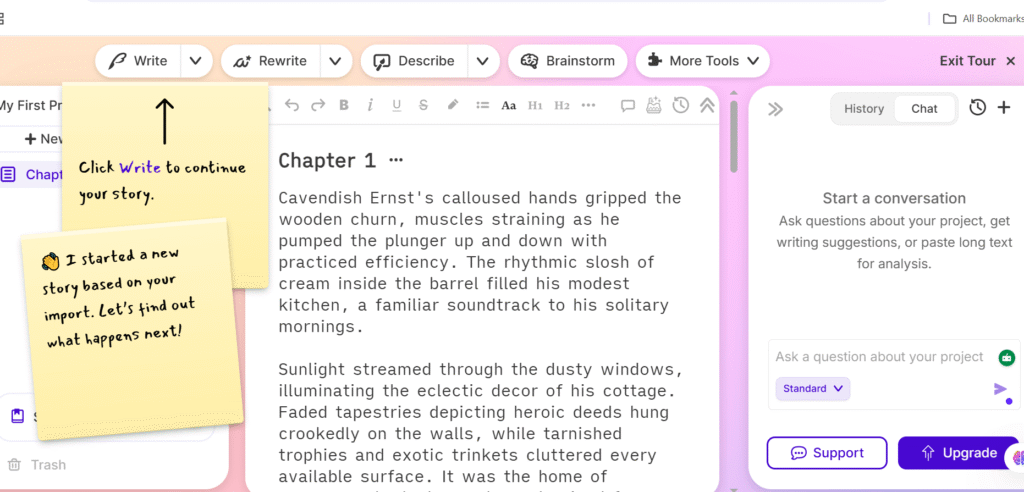
The Expand feature takes sparse descriptions and adds sensory richness. I’d write: “Detective Morgan entered the abandoned warehouse.” Sudowrite would suggest: “Detective Morgan’s footsteps echoed off rusted metal beams as she pushed through the warehouse’s sagging door. Stale air, thick with the ghost of old oil and decay, coated the back of her throat.”
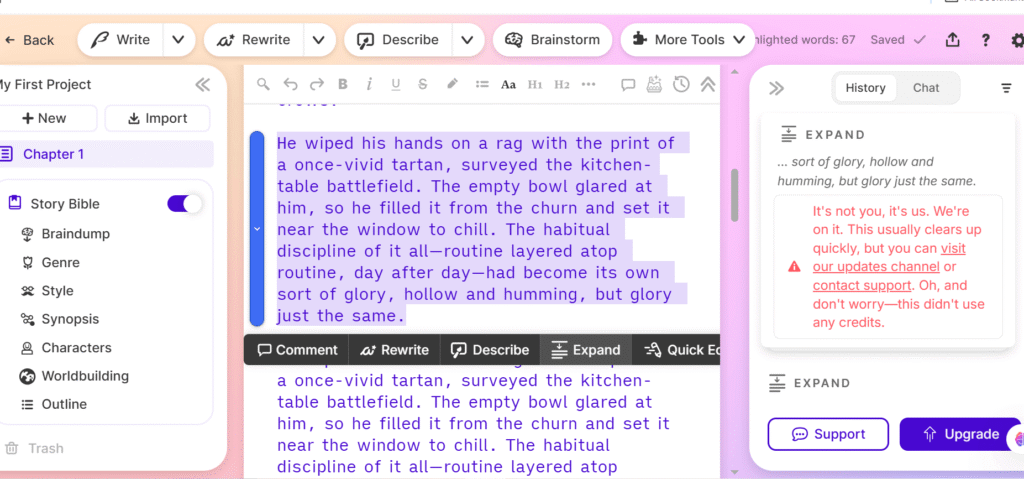
Rewrite saved me during second-draft hell. Every novelist knows that moment when you read your own prose and cringe. Sudowrite offers alternative phrasings—sometimes better, sometimes worse, always educational.
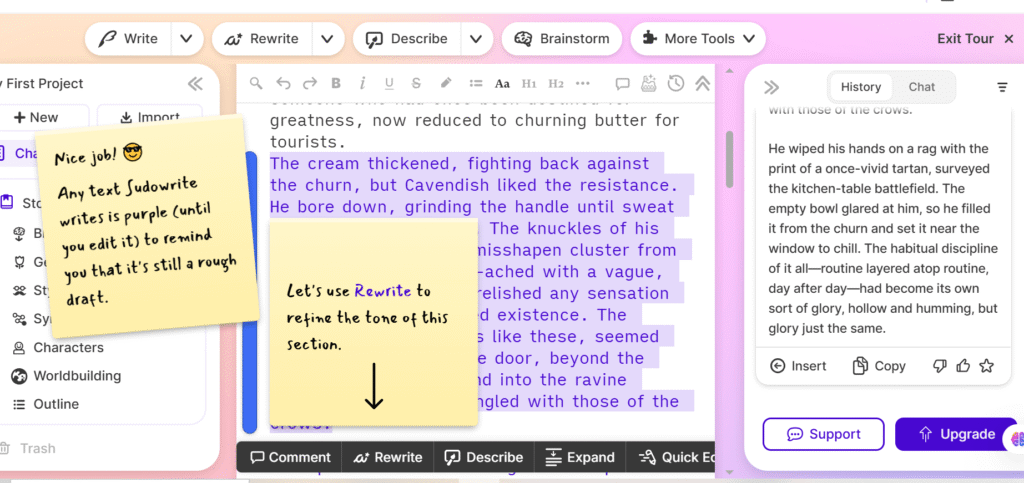
Sensory language enriches every scene. Sudowrite pushes you beyond sight and sound into taste, touch, and smell. My initial drafts lived entirely in characters’ heads. Sudowrite reminded me readers experience stories through all five senses.
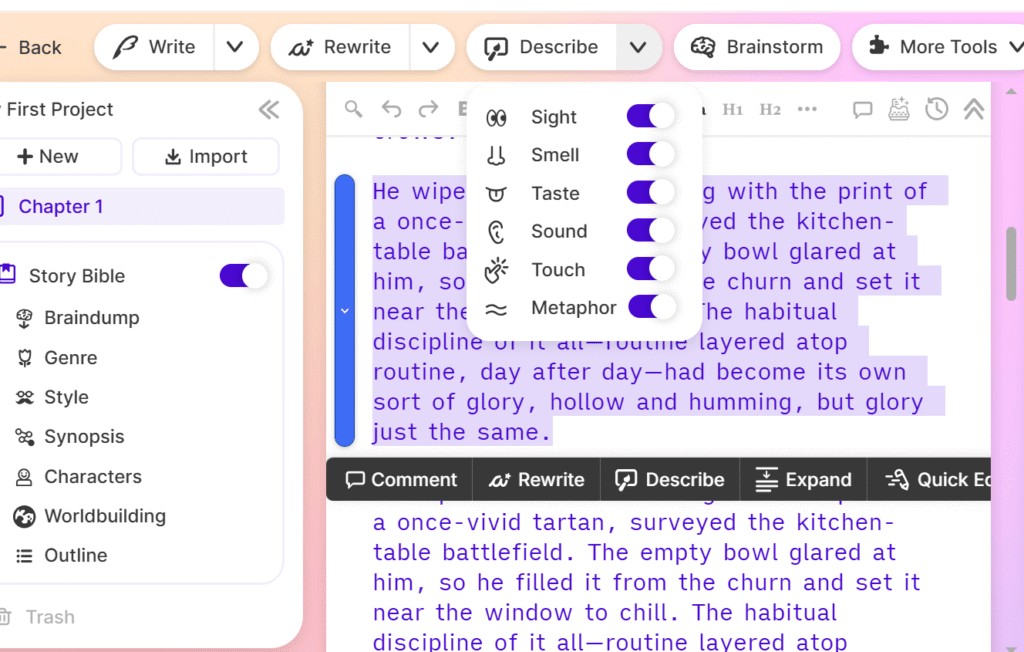
Not replacing my writing—enhancing it.
However, Sudowrite isn’t perfect. Its suggestions sometimes veer purple or overly flowery. You need judgment to accept brilliant additions while rejecting overwrought prose. Think of it as an enthusiastic writing partner who sometimes needs reining in.
Among AI story generators, I use Sudowrite primarily during revision, not initial drafting. First drafts need speed and momentum. Polish comes later.
Novelcrafter: The Best Novel Writing Software for Long Books
Novelcrafter one of the professional writing AI tool solved my biggest problem: I kept losing track of my own story.
With ChatGPT for planning and Sudowrite for prose, I still needed something to hold everything together. Microsoft Word wasn’t cutting it. Scrivener felt overly complex.
The Lore Bible changed how I approached world-building. Instead of scattered notes across seven documents, I built a searchable database. Every location, every plot device, every historical detail lived in one place.
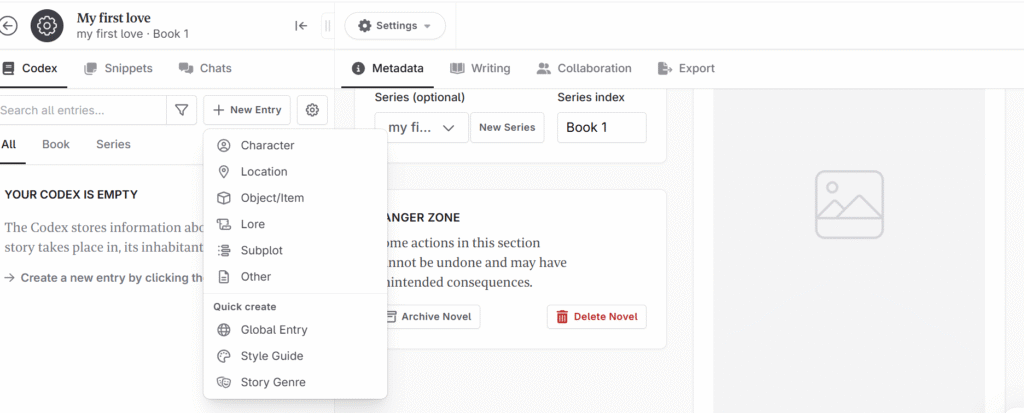
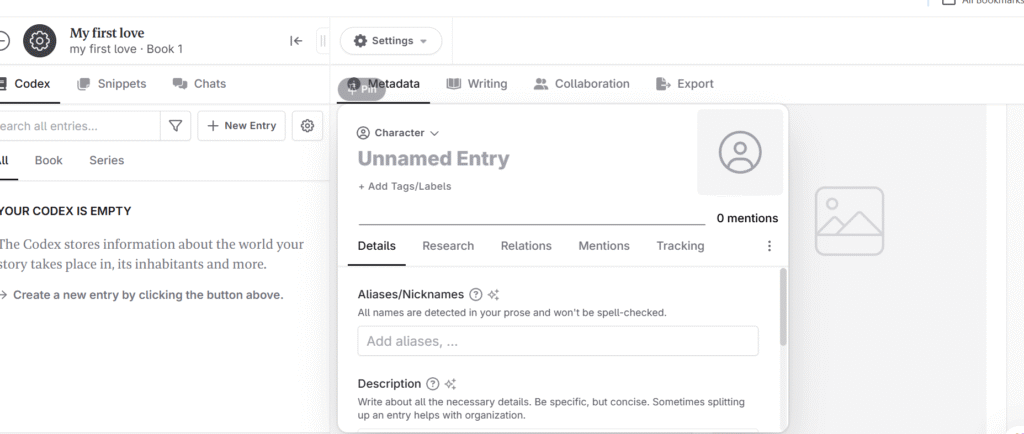
Character database tracks more than physical descriptions. I logged motivations, relationships, arc progressions, and scene-by-scene development. Watching my protagonist evolve from chapter one through chapter forty-two revealed patterns I’d never noticed.
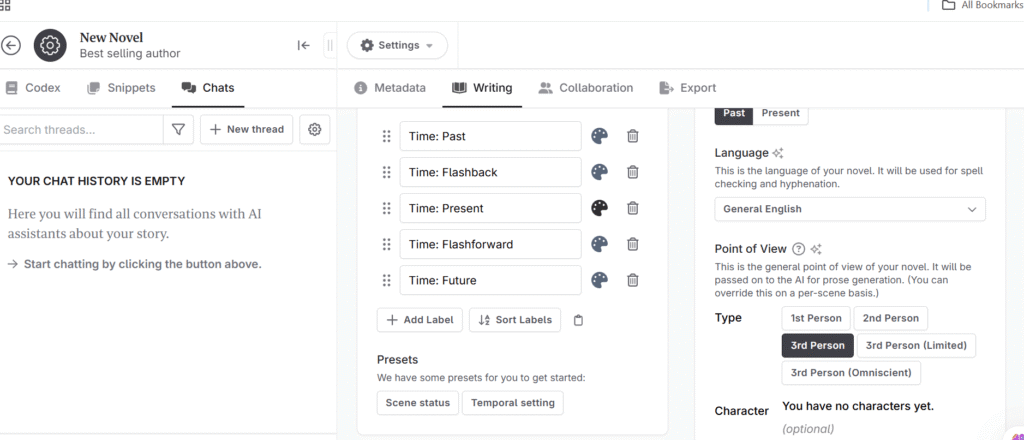
Timeline prevented chronological disasters. My mystery spanned three weeks of story time across six months of real-world writing. Without Novelcrafter’s timeline view, I absolutely would have screwed up which events happened when.
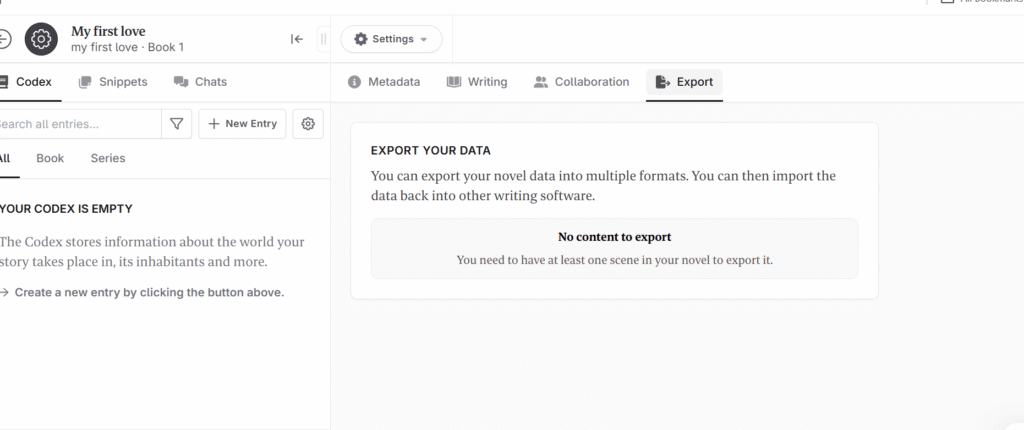
Exportable manuscript means actually finishing. Novelcrafter exports standard manuscript format: headers, page numbers, proper formatting. From Novelcrafter to agent submission—smooth transition.
The interface takes some learning. It’s not as immediately intuitive as Google Docs. But spend an hour learning Novelcrafter’s features (novel writing software 2026), and you’ll save dozens of hours during revision.
My Step-by-Step AI Novel Writing Workflow (From Idea to Manuscript)
Theory means nothing without application. Here’s my step-by-step process:
Week One: Plot in ChatGPT
I start with premise, protagonist, and conflict. ChatGPT helps me develop these into a three-act structure with major plot points. We identify the inciting incident, first act break, midpoint twist, dark night of the soul, and climax.
Then we drill down into chapter-by-chapter beats. Not writing scenes yet—just establishing what needs to happen when.
Week Two: Set Up Novelcrafter
Before writing a single scene, I build the infrastructure. Character profiles with photos, personality traits, and relationship maps. World-building documents for settings, rules, and historical context.
This preparation feels slow. It pays off massively during drafting.
Weeks Three Through Twelve: Draft
I draft directly in Novelcrafter, but I keep Sudowrite open in another tab. When descriptions feel flat, I’ll paste them into Sudowrite for expansion.
My daily goal: 1,500 words of new material. Not perfect words. Just forward momentum.
Weeks Thirteen Through Sixteen: First Revision with ChatGPT
With a complete messy draft, I ask ChatGPT to analyze chapter by chapter. What works? What drags? Where does logic break down?
This feedback identifies structural problems prose polish can’t fix.
Weeks Seventeen Through Twenty: Polish with Sudowrite
Now the prose gets attention. Scene by scene, I use Sudowrite to enhance descriptions, vary sentence rhythm, and eliminate repetitive phrasing.
The goal: every paragraph earns its place.
Week Twenty-One: Final Export
Novelcrafter exports my completed manuscript in standard format. I do a final proofread, then it’s ready for beta readers, agents, or publication.
This isn’t theoretical. It’s exactly how I wrote my thriller manuscript.
Which AI Writing Tool Is Best for Your Novel?
|
Best AI Tool for Beginner Novel Writers |
Chatgpt |
Master structural thinking before adding complexity. Once you’ve outlined and drafted a complete manuscript, add Sudowrite for prose enhancement. |
|
Best AI Tools for Professional Authors |
Chatgpt, Novelcrafter, and Sudowrite |
ChatGPT provides strategic thinking, Sudowrite elevates craft, and Novelcrafter prevents organizational chaos. |
|
Best AI Tools for Series Writers and World-Building |
Novelcrafter |
Tracking characters, plot threads, and world-building across multiple books without robust organization? That’s madness. |
Budget matters too. ChatGPT Plus costs $20 monthly. Sudowrite runs around $19-59 monthly. Novelcrafter adds another $4-20 monthly. That’s $43-99 total—less than most writing conferences, and these tools work year-round.
Free alternatives exist, but they lack specialized fiction features. Google Docs is free but offers no AI assistance. Free ChatGPT works but lacks the memory and advanced features of Plus. Hemingway Editor polishes prose but doesn’t understand story structure.
For AI tools for creative writers, you generally get what you pay for.
Final Verdict: The Best AI Tools for Novel Writing in 2026
After writing multiple manuscripts using various combinations, my verdict remains consistent: ChatGPT handles the thinking—plot logic, character development, structural problems. It’s the strategist that keeps your story coherent.
Sudowrite manages the language—vivid descriptions, varied prose, sensory details. It’s the artist that makes your writing enjoyable to read.
Novelcrafter controls the structure—organization, consistency, timelines. It’s the architect that prevents creative chaos.
Together, they form the best AI tools for novel writing available. Not because they’re perfect individually, but because they complement each other’s strengths.
Could you write a novel using just one? Absolutely. People wrote incredible novels using only typewriters and index cards. But why make it harder than necessary?
Modern AI writing assistants for authors accelerates the craft without replacing it. These tools handle the mechanical heavy lifting so you focus on storytelling, character development, and thematic depth—the irreplaceable human elements that make fiction worth reading.
FAQs
1. Is ChatGPT good enough to write a full novel?
ChatGPT alone cannot write a publishable novel, but it can help you write one. The distinction matters. However, ChatGPT excels as a collaborative partner. Use it for plotting, brainstorming, solving story problems, and analyzing draft consistency. Think of ChatGPT as an incredibly knowledgeable writing teacher available 24/7.
2. Is Sudowrite better than ChatGPT for fiction?
They serve completely different purposes. It’s not a competition—it’s a collaboration. Sudowrite specifically focuses on prose-level fiction writing. It understands show-don’t-tell, sensory description, and narrative voice in ways ChatGPT doesn’t. ChatGPT dominates structural thinking, plot logic, and analytical problem-solving. Professional fiction writers use both. ChatGPT during planning and structural revision. Sudowrite during drafting and prose refinement.
3. Can AI replace human writers?
No, and this question misunderstands what AI actually does. Current AI tools excel at pattern recognition and language generation. They can produce grammatically correct sentences and suggest plot structures based on genre conventions.
What they cannot do: create genuinely original stories with authentic emotional depth, develop truly unique characters, or understand the subtle thematic resonance that makes great literature endure. I’ve tested every major AI writing tool available. None can replicate the human capacity for meaning-making and emotional truth that transforms words into art. AI assists the creative process. It doesn’t replace it.
4. Can I legally publish a book written by AI?
The legal landscape remains murky, but here’s current understanding: Pure AI-generated content likely doesn’t qualify for copyright protection. U.S. Copyright Office guidelines suggest human authorship is required. However, books created through human-AI collaboration receive different treatment. If you provide creative direction, make selection decisions, and contribute original writing, the resulting work may qualify for copyright protection.
The practical approach: use AI as a writing assistant, not a ghostwriter. Let it help with brainstorming, outlining, and revision suggestions—but ensure substantial human creativity shapes the final manuscript.
The future of novel writing isn’t human versus AI. It’s human writers amplified by AI tools, creating better books faster while maintaining the irreplaceable human elements that make fiction worth reading.
Leave a Reply