

You know that feeling? You’re sitting there, blank document open, cursor just… blinking at you. Mocking you, really. It’s not that you can’t write. You just don’t know what to write about yet. That’s exactly where ChatGPT for brainstorming comes in—and honestly, it’s been a game-changer for me. I’m not talking about having AI write your book (please don’t). I’m talking about using it to generate the raw material you can shape into something actually yours.
Let me walk you through how I’ve used it to break through those awful creative walls.
Why Writers Use ChatGPT for Brainstorming Novels
Here’s something most writing advice glosses over: the problem usually isn’t talent. It’s having enough raw material to work with.
You need seeds. Those little sparks of “ooh, what if?” that get you excited enough to actually write.
That’s what Novel brainstorming AI does really well—it acts like a “possibility machine.” Instead of sitting around waiting for the muse to show up (she’s chronically late, by the way), you can actively generate dozens of potential directions in minutes. Think of it like having a writing buddy who never gets tired, never judges your half-baked ideas, and always says, “Okay, but what if we tried THIS?”
When I started doing AI-powered brainstorming, my notebooks filled up faster than ever. Not with beautiful prose—with messy questions, conflicts, scenarios I could actually run with.
How to Use ChatGPT for Brainstorming a Novel
The process is pretty straightforward once you get the hang of it. Here’s what’s worked for me across a bunch of projects.
Start with a vague idea
Don’t overthink this. You just need something—anything—to point the AI in a direction.
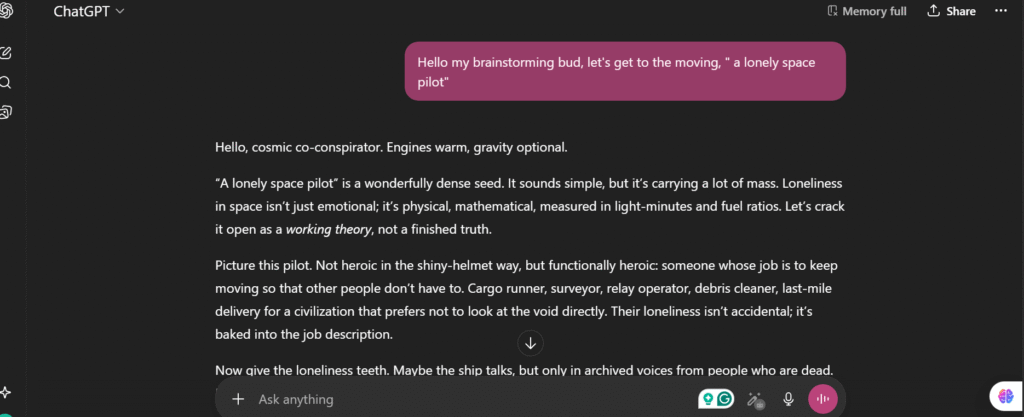
Like: “a lonely space pilot” or “a historian discovers something she shouldn’t” or “siblings meet again after twenty years of silence.”
Vague is fine. Actually, vague is good. You’ll get specific later.
Ask for expansion
This is where you multiply your options.
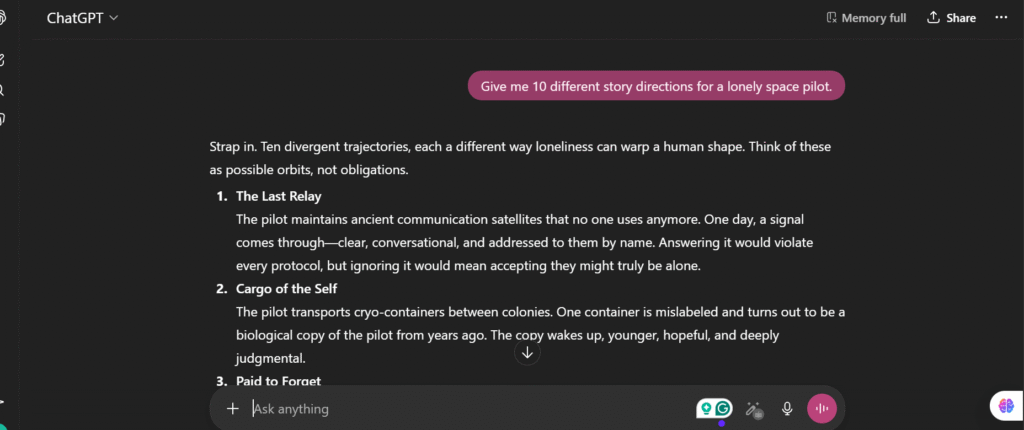
Try something like: “Give me 10 different story directions for a lonely space pilot.”
You’ll get stuff like: rescue missions gone sideways, first contact scenarios, AI companions that turn creepy, memory loss mysteries, cargo runs with impossible moral choices. Each one branches off differently.
Pick whichever makes your brain go “oh, wait…”
Ask for conflict
Stories without friction are just… descriptions of people having okay days. You need something to go wrong.
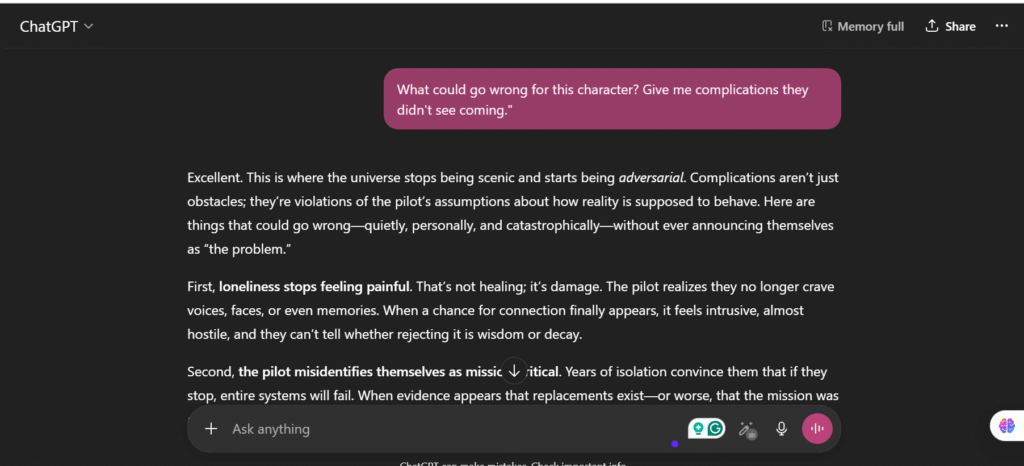
Prompt it: “What could go wrong for this character? Give me complications they didn’t see coming.”
This is where you’re actually in the story concept development phase. Conflict shows you who your character really is. Problems create plot.
Ask for stakes
Okay, but why should anyone care?
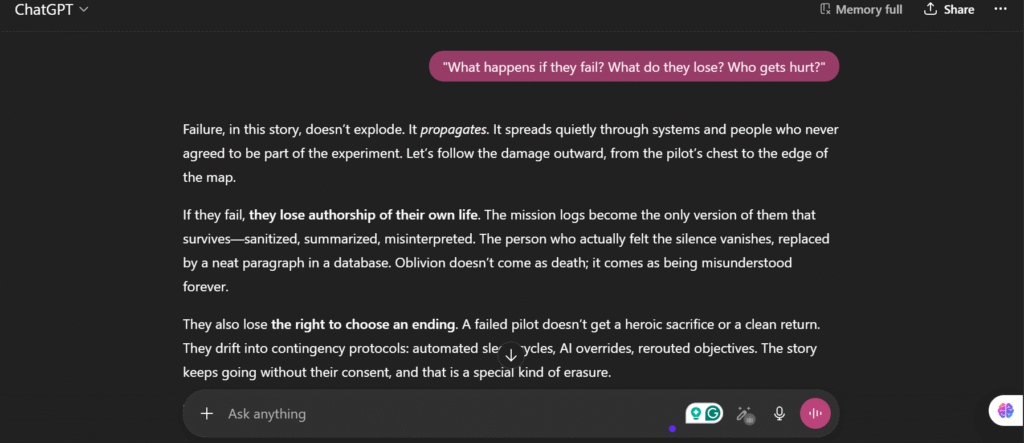
“What happens if they fail? What do they lose? Who gets hurt?”
Stakes make the difference between “something happens” and “something that matters happens.” I’ve noticed that personal stakes—relationships, identity, moral lines they swore they’d never cross—hit way harder than “the world will end” stuff.
Ask for twists
Now make it weird. Push it somewhere unexpected.
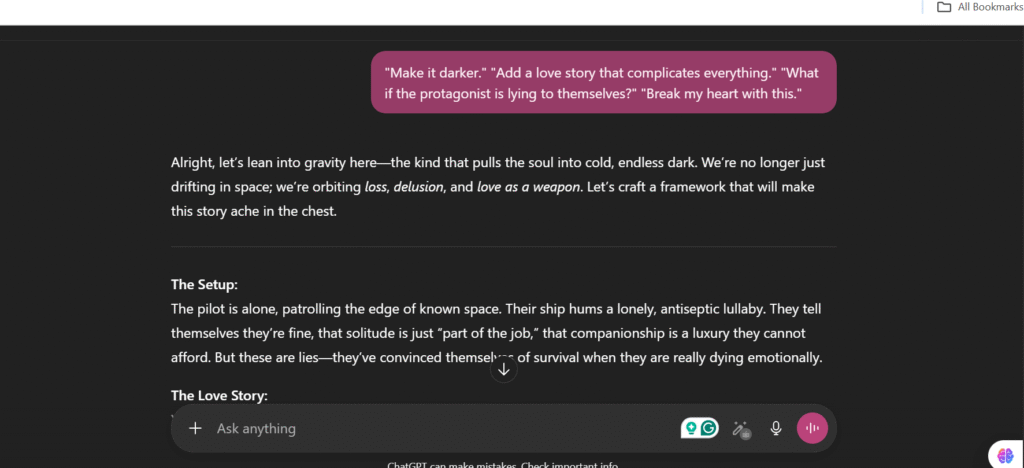
“Make it darker.” “Add a love story that complicates everything.” “What if the protagonist is lying to themselves?” “Break my heart with this.”
This is where generic becomes distinctive. You’re not just brainstorming anymore—you’re sculpting.
How ChatGPT Brainstorms Stories
Understanding what’s happening under the hood helps you use it better.
ChatGPT isn’t inventing from scratch—it’s connecting patterns it recognizes from millions of stories. It’s a pattern synthesizer. It knows lonely characters often deal with isolation, space settings involve survival, and pilots have control issues. It mixes these in fresh combinations that feel story-like because they echo narrative structures that actually work.
What you get are seeds—not complete plots, but promising starting points worth exploring.
Using ChatGPT as a Novel Idea Generator
One seed can become completely different genres depending on where you take it.
Watch this: “A woman finds a letter addressed to her that she never received.”
Romance: The letters from her first love, written twenty years ago, reveal why they really broke up—and it changes everything.
Thriller: The letter has coordinates, a warning, and mentions her daughter by name. She doesn’t have a daughter.
Fantasy: It’s in her own handwriting, describing events that haven’t happened yet.
Sci-fi: The letter’s from a parallel timeline where she made different choices.
Literary fiction: The letter forces her to face who she became versus who she meant to be.
This is novel premise generation in real time. Same seed, totally different stories. I do this whenever I’m between projects and need to figure out what I actually want to write next.
The AI story idea generator doesn’t care about genre conventions or market trends—which means you get raw possibilities you can later refine.
ChatGPT Plot Ideas: From Seed to Story
Let me break down turning a basic concept into ChatGPT plot ideas, something actual you can work with.
Start with: “A chef discovers her restaurant is built on an ancient burial ground.”
Now develop it:
- Who is she? What matters most to her? What’s she running from?
- What’s her goal? Save the restaurant? Understand the spirits? Sell and get out?
- What’s in her way? The spirits grow stronger. Health inspectors. Her business partner has secrets. She’s losing it—or is she?
- Where does this build toward?
Your prompt sequence looks like:
“I have a chef who discovers her restaurant sits on an ancient burial ground. Help me develop her character—flaws, desires, all of it.”
“What’s her main goal in this story?”
“What’s stopping her? Give me supernatural AND personal challenges.”
“How could this reach an emotional peak?”
Each answer gives you structure. You’re building scaffolding you’ll fill in with your own voice later.
Creative Prompts for Writers Using ChatGPT (Prompts I Actually Keep in My Notes)
Want to speed things up? Here are ChatGPT creative prompts I use constantly:
Character:
- “Create someone whose greatest strength is also their fatal flaw.”
- “Describe someone haunted by a choice they didn’t make.”
- “Give me a character who thinks they’re the hero but might be the villain.”
World-building:
- “Design a society where the thing we value most is forbidden.”
- “What if everyone knew exactly when they’d die?”
- “Create a world where technology evolved totally differently.”
Twists:
- “What if the mentor is secretly working against the protagonist?”
- “How could the thing everyone’s chasing turn out to be worthless?”
- “What if solving the mystery makes everything worse?”
Theme:
- “Build a story around: home is something you create, not somewhere you return to”
- “Explore what happens when forgiveness becomes impossible.”
- “Show me a story about the cost of being right.”
These creative prompts for writers work because they’re specific enough to generate good material but open enough for you to fill in the gaps.
How ChatGPT Helps Beat Writer’s Block
Let’s be real about this.
Writer’s block isn’t about motivation or discipline. It’s about the terror of that blank page.
ChatGPT dissolves that in three ways:
- It gives you something to react to. You’re not generating everything from nothing—you’re responding, refining, rejecting, remixing. That’s so much easier. Our brains are way better at editing than creating from zero.
- It removes judgment from the messy early stages. You can explore terrible ideas without consequences. Zombie apocalypse in a bakery? Go for it. No one’s judging. Some of my best concepts started as deliberately absurd questions.
- It creates momentum. Once you’ve got ten possibilities on screen, you naturally start thinking about eleven, twelve, and thirteen. Ideas breed more ideas.
I’ve seen so many writers get unstuck just by asking ChatGPT to generate bad ideas on purpose. Something about removing the pressure of quality actually unleashes creativity.
How This Fits Into Writing a Full Novel With ChatGPT
Brainstorming is just step one.
The full process looks like: Brainstorming → Outline → Chapters → Editing
What we’ve covered here is gathering material, exploring directions, and finding the story that won’t let you go.
From here, you’ll structure that material into an outline, expand scenes into chapters, then revise everything until it sounds like you—because you did write it. You just had help generating the raw ingredients.
This works because it separates idea generation from execution. You’re not trying to write brilliantly while simultaneously inventing the story. You’re doing them one at a time, which is honestly how most successful writers work anyway—they just don’t always admit it.
Look, brainstorming with ChatGPT isn’t about letting AI write your novel. It’s about removing the friction between “I want to write” and “I have something worth writing about.”
Start messy. Generate way more than you need. Be honest about what actually excites you when it appears on screen.
The story worth writing is in there somewhere—you just need enough raw material to find it.
FAQs
1. How to brainstorm ideas with ChatGPT?
Give it a basic concept, character, or question. Then systematically ask it to expand, complicate, and twist that idea. Use prompts like “give me 10 directions this could go,” “what conflicts could emerge,” “what if this got darker/funnier/weirder.” Treat it like a conversation, not a one-and-done. Build on each response. I usually go through 15-20 exchanges before landing on something that genuinely excites me.
2. Can I write a novel with ChatGPT?
Yes, but let’s be clear about what that means. ChatGPT is great at generating ideas, expanding concepts, creating structure, and helping you get unstuck. What can’t it do? Write in your voice, make real artistic choices, or produce prose that feels genuinely human without serious editing. Best approach: use ChatGPT for brainstorming, outlining, rough drafting—then rewrite everything in your own voice. You’re the lead writer; it’s the assistant helping you generate raw material faster. The revision is all yours.
3. How to brainstorm an idea for a novel?
Start with any fragment that interests you—a character trait, a what-if question, a setting, an emotional tone, a theme. Feed it into ChatGPT and ask for multiple directions. Don’t commit yet. Collect 20-30 possibilities first. Then notice which one you keep thinking about, the one that makes you ask more questions. Use ChatGPT to develop that by adding conflict, stakes, complications, and twists. You’re not looking for perfect—you’re looking for interesting enough that you’ll still care 60,000 words later.
4. What are some good prompts for ChatGPT?
The best ones are specific but open-ended. Instead of “give me a story idea,” try “create a protagonist whose job directly conflicts with their deepest fear” or “what happens when someone discovers they’ve been lied to about something fundamental to who they are?” Good prompts ask for complications, not solutions: “What could go wrong?” “Who would oppose this character?” “What makes this situation impossible to solve easily?” I’ve found that prompts about character contradictions, moral dilemmas, and unexpected consequences generate the most useful stuff. Always follow up with “make it more specific” or “give me a version that destroys me emotionally.”
5. What are the best AI tools to use alongside ChatGPT for brainstorming?
ChatGPT is excellent for idea generation, character exploration, and plot expansion, but many writers pair it with other AI tools for outlining, drafting, and editing. If you’re working on a tight budget, there are also several free AI writing tools for novel writing that complement ChatGPT perfectly for early brainstorming and experimentation.
Leave a Reply