
If you’ve ever searched for a list of good prompts for ChatGPT, you’ve probably seen endless copy-paste templates. They look helpful. They rarely are.
From my own experience as a student and teacher, I learned this the hard way: ChatGPT doesn’t make you smarter by default—you have to use it deliberately. When you treat it like a shortcut, it weakens your thinking. When you treat it like an instructor, it sharpens it.
This guide shows you how to use ChatGPT for studying without cheating, without sounding robotic, and without sabotaging your exams. You’ll learn how to think first, prompt second, and verify always—because that’s how real learning sticks.
Why Most Students Use ChatGPT Wrong
It starts innocently, then spirals fast. One copied answer becomes a habit.
The copy–paste trap
Most students use ChatGPT for homework help by asking for direct answers. They paste. They submit. They move on. The problem? Their brain never engages.
I noticed this when a friend copied an AI-generated solution for a biology assignment—come exam day, he froze completely on the same topic because he’d never practiced recalling the information himself.
Why AI-written answers hurt exam performance
When you rely on AI-generated responses, you skip the struggle phase. That struggle—confusion, effort, correction—is where memory forms.
I once let ChatGPT summarize an entire history chapter for me, and during the test, I realized I couldn’t explain even the main events without the summary in front of me. AI-powered learning fails when you outsource thinking instead of supporting it.
What research says about active learning
Studies on active learning consistently show that explaining concepts, self-testing, and applying ideas improves retention, while passive reading delivers lower long-term comprehension.
For example, research in medical education found that students who actively generate explanations and test themselves retain knowledge far better than those who only review material (PubMed).
That’s why AI tools for students work best when they force interaction, not consumption, prompting you to think, explain, and reflect rather than just copy answers.
The L.E.A.R.N. Framework (A Smarter Way to Write ChatGPT Prompts)
Instead of random prompts, I use the L.E.A.R.N. framework. It’s simple, memorable, and practical.
| Step | What it Means | Example |
| L – Learning goal | Start with what you want to achieve, not just what you want explained. | • I want to understand, not memorize, this concept.• I want to identify the main arguments in this essay.• I want to be able to solve these types of problems independently. |
| E – Explanation style | Tell ChatGPT how to teach you. | • Explain this using a real-life analogy.• Break it down into a step-by-step guide.• Compare it to something I already know. |
| A – Academic level | Match the explanation to your syllabus or skill level. | • Explain as if I’m a beginner in biology. Explain this at undergraduate level.• Use technical terms suitable for AP Physics students. |
| R – Review method | Force yourself to recall or reflect on what you learned. | • Quiz me after explaining.• Give me 5 multiple-choice questions to test my understanding.• Ask me to summarize the key points in my own words. |
| N – Next-step task | End with an actionable step to apply or practice. | • Give me one practice question.• Ask me to create a short essay using this concept.• Suggest a real-life application I can try today. |
Used together, this framework transforms writing better AI prompts into a skill—not a guess.
List of Good Prompts for ChatGPT Based on Learning Goals
These aren’t random. Each one serves a specific outcome. Consider this section your list of good prompts for ChatGPT, refined through real study use.
Prompts for Understanding Complex Topics
Prompt:
“Explain [topic] like I’m preparing to teach it tomorrow. Use one analogy and one example.”
- Helps with: Deep understanding
- When to use: Before lectures or revisions
- Personalize: Add your subject and academic level
Prompts for Memorization & Recall
Prompt:
“Turn this topic into 5 questions, then test me without showing answers first.”
- Helps with: Active recall
- When to use: Night before revision
- Personalize: Ask for MCQs or short answers
Prompts for Writing in Your Own Voice
Prompt:
“Help me outline this answer, but don’t write it. Ask me questions instead.”
- Helps with: Original writing
- When to use: Essays or reports
- Personalize: Mention word count and tone
This is where ChatGPT prompts for students often go wrong—structure beats spoon-feeding.
Prompts for Exam Preparation
Prompt:
“Act as an examiner. Ask me one question, wait for my answer, then critique it.”
- Helps with: Exam performance
- When to use: Final revisions
- Personalize: Add marking criteria
Prompts for Time-Strapped Students
Prompt:
“I have 20 minutes. What should I focus on to maximize marks for this topic?”
- Helps with: Time efficiency
- When to use: Busy days
- Personalize: Mention your exam weightage
Effective Chatgpt Prompts: Bad vs. Smart vs. Elite Prompts
| ❌ Bad Prompt | ✅ Smart Prompt | 🚀 Elite Prompt |
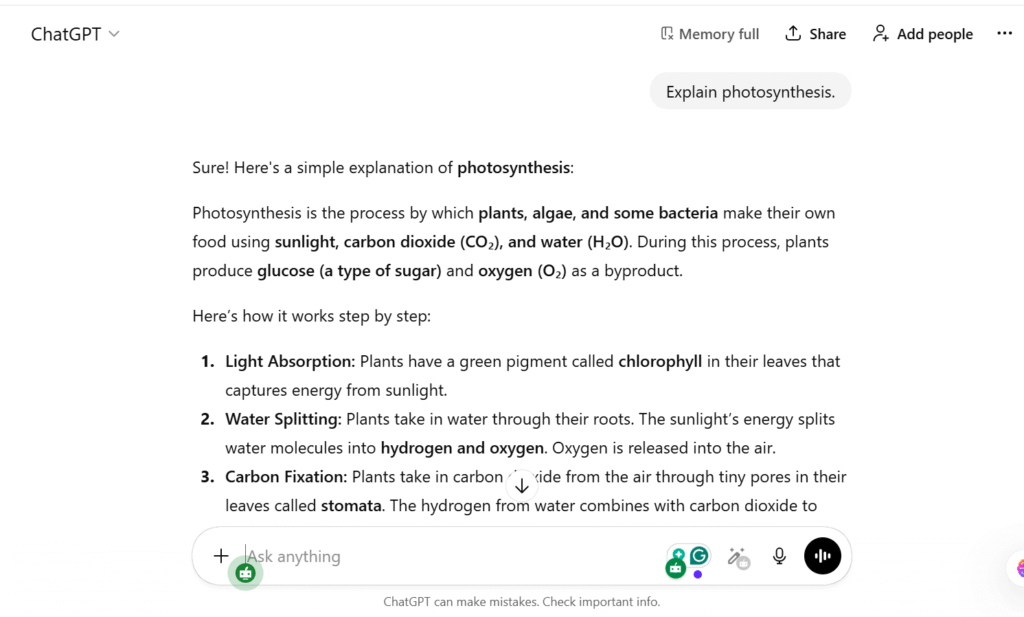
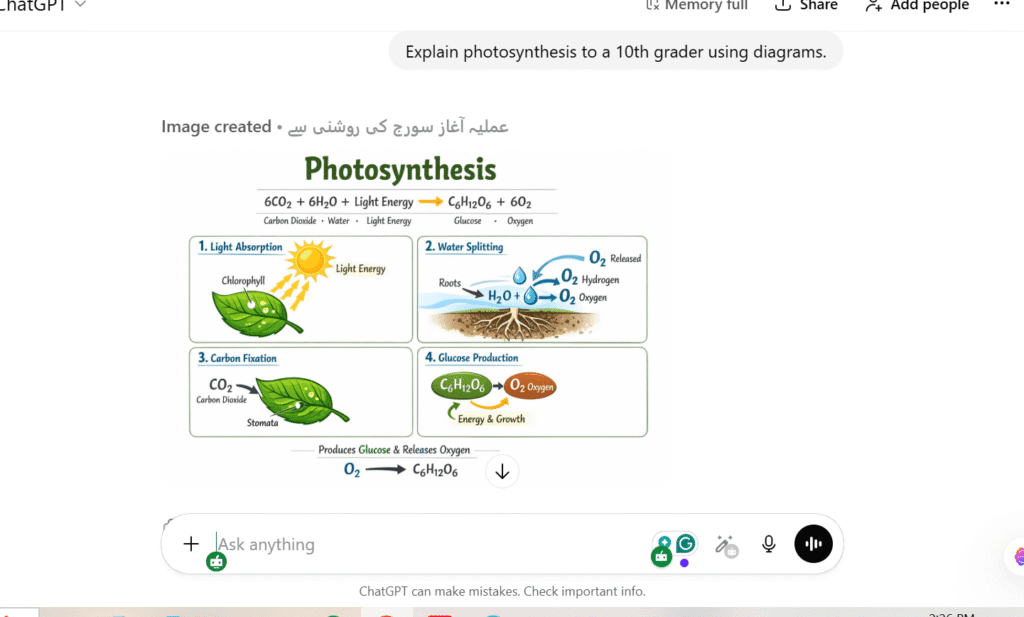
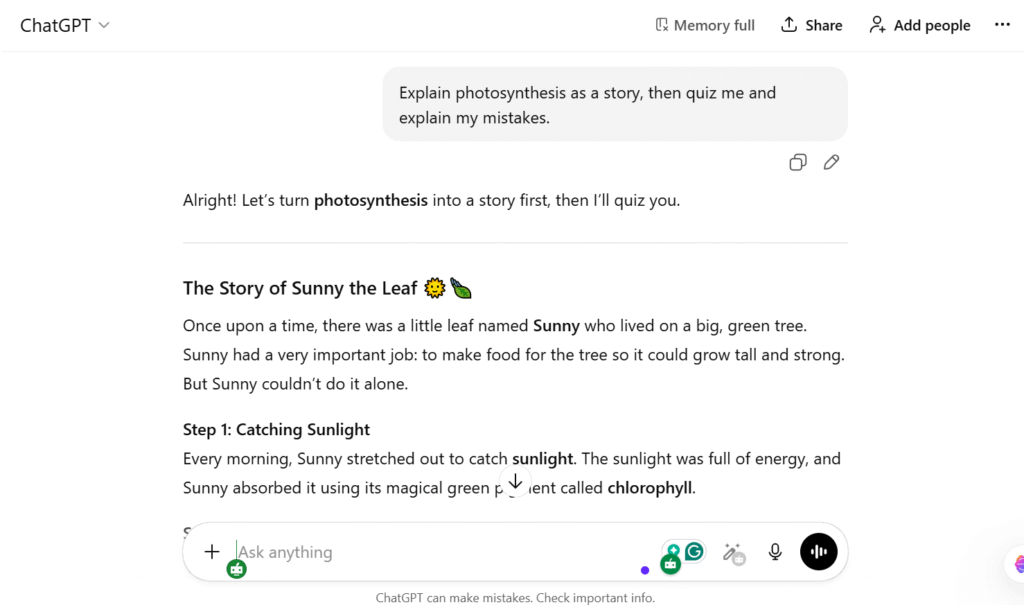
| Explain photosynthesis. | Explain photosynthesis to a 10th grader using diagrams. | Explain photosynthesis as a story, then quiz me and explain my mistakes. |
| Summarize World War II. | Summarize World War II with key events and dates for a high school report. | Summarize World War II as a timeline story, then test me with 5 questions about key events. |
| Write an essay on climate change. | Help me outline an essay on climate change with 3 main arguments. | Guide me to outline an essay on climate change, ask probing questions, and suggest examples I can include. |
The difference? The elite prompt forces engagement. That’s effective ChatGPT prompts in action.
Bad prompt example
Smart Prompt Example
Elite Prompt Example
ChatGPT Study Mode vs Manual Prompts (When to Use Each)
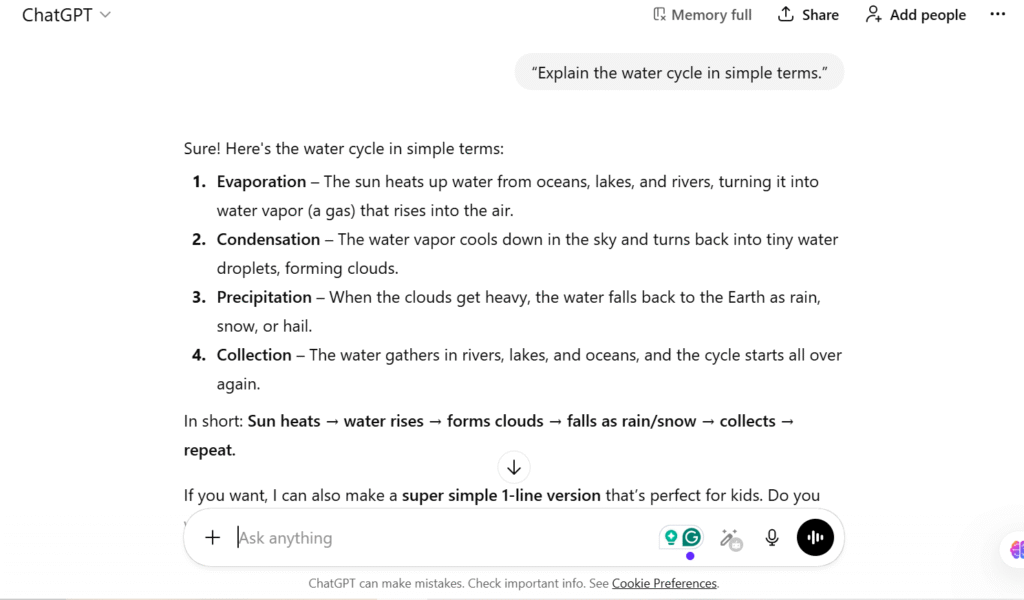
Study Mode: Good for quick clarification
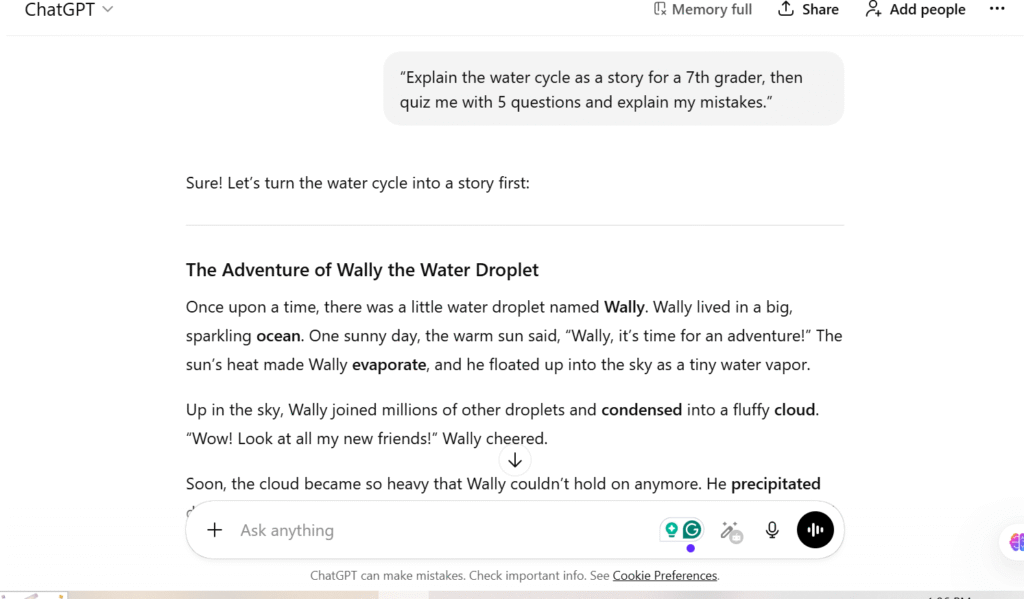
Manual Prompts: Better for deep learning
I personally switch between both. For serious studying, I prefer AI prompts for studying that I write myself. They feel intentional, not automated.
| Mode | Example Prompt | What You Get / Best Use |
| Study Mode | “What is osmosis in simple terms?” | Quick clarification. Great for definitions, short explanations, or reviewing a concept before class. Fast and direct, but less interactive. |
| Study Mode | “Explain Newton’s 2nd law in one paragraph.” | Quick, easy-to-digest summary. Perfect for last-minute concept refreshers. |
| Manual Prompts | “Explain photosynthesis as a story, then quiz me with 5 MCQs and explain my mistakes.” | Deep understanding. Forces active recall, reflection, and engagement with the topic. |
| Manual Prompts | “Turn the causes of World War I into 5 questions, test me, and provide explanations for each answer.” | Builds retention through practice testing. Ideal for exam prep or mastering complex topics. |
| Manual Prompts | “Help me outline an essay on climate change, then ask questions so I write my own examples.” | Encourages original writing and critical thinking. Great for assignments and essay practice. |
Tip: Use Study Mode when you need fast answers or clarification, and Manual Prompts when your goal is long-term understanding, exam readiness, or writing improvement.
AI Ethics for Students
Using ChatGPT wisely isn’t about rules—it’s about learning smart, not cheating yourself. Think of it like traffic lights:
| Zone | What It Means | Examples / Tips |
| 🟢 Green – Safe Use | These uses boost your learning without replacing your thinking. | • Ask ChatGPT to explain tricky concepts in your own words. • Generate practice questions and attempt them yourself. • Get feedback on your own answers, not ready-made solutions. |
| 🟡 Yellow – Risky Use | These might save time but can weaken your brain’s work-out if overused. | • Asking ChatGPT to rewrite your assignments instead of drafting yourself. • Relying only on summaries instead of engaging with the material. Tip: Use these sparingly, then try to explain the same topic yourself. |
| 🔴 Red – Academic Misconduct | These cross the line—your brain gets bypassed entirely. | • Submitting AI-written work as your own. • Letting ChatGPT answer everything for homework or exams. Rule of thumb: if it removes thinking, it’s red. |
Remember: Using ChatGPT for homework help isn’t wrong. The problem starts when you outsource thinking instead of learning. Treat it like a smart tutor: ask, reflect, and practice—don’t let it do the work for you.
How to Build a 30-Minute AI Study Session
Here’s a realistic workflow I’ve used myself:
- 5 min: Define goal (e.g., “I want to understand the causes of the French Revolution.”)
- 10 min: Ask one L.E.A.R.N.-based prompt (e.g., “Explain the causes of the French Revolution as a story, then quiz me with 5 questions.”)
- 10 min: Answer questions manually (e.g., write down answers and reasoning without looking at AI responses first.)
- 5 min: Review mistakes (e.g., check your answers against AI feedback, note gaps, and clarify misunderstandings.)
That’s it. Simple. Effective. Sustainable.
Final Takeaway – AI Doesn’t Replace Learning, It Shapes It
ChatGPT isn’t your brain. It’s a tool. When used strategically, it becomes a powerful instructor. When abused, it becomes a crutch.
The smartest students don’t look for shortcuts—they look for leverage. And that’s exactly what a well-crafted list of good prompts for ChatGPT provides.
FAQs
1. How can I prompt ChatGPT effectively as a student?
Start with your learning goal rather than the answer you want. For example, ask ChatGPT to help you understand a concept, quiz you, or create practice questions. This way, AI-powered learning supports your thinking instead of replacing it.
2. What are the best prompts for studying with ChatGPT?
Focus on prompts that explain, quiz, and challenge you. Avoid asking ChatGPT to simply write your homework. Use prompts that guide you to think, apply, and retain information—this is how you truly benefit from ChatGPT for homework help.
3. What are some good writing prompts for students?
Use prompts that help you structure your work and get feedback without doing the writing for you. For instance, you can ask ChatGPT to outline an essay, suggest examples, or quiz you on key points. This develops your skills and ensures your writing remains original.
4. How do I give good prompts to ChatGPT?
Be specific, outcome-focused, and interactive. Include your topic, learning goal, academic level, and desired format. For example, instead of saying “Explain photosynthesis,” ask, “Explain photosynthesis as a story for a 10th grader, then quiz me with 5 MCQs.” This turns writing better AI prompts into an effective study strategy.
Note: Keep up with tech news and AI news, but don’t blindly follow trends like janitor ai.Tools change. Thinking skills don’t.
Leave a Reply