
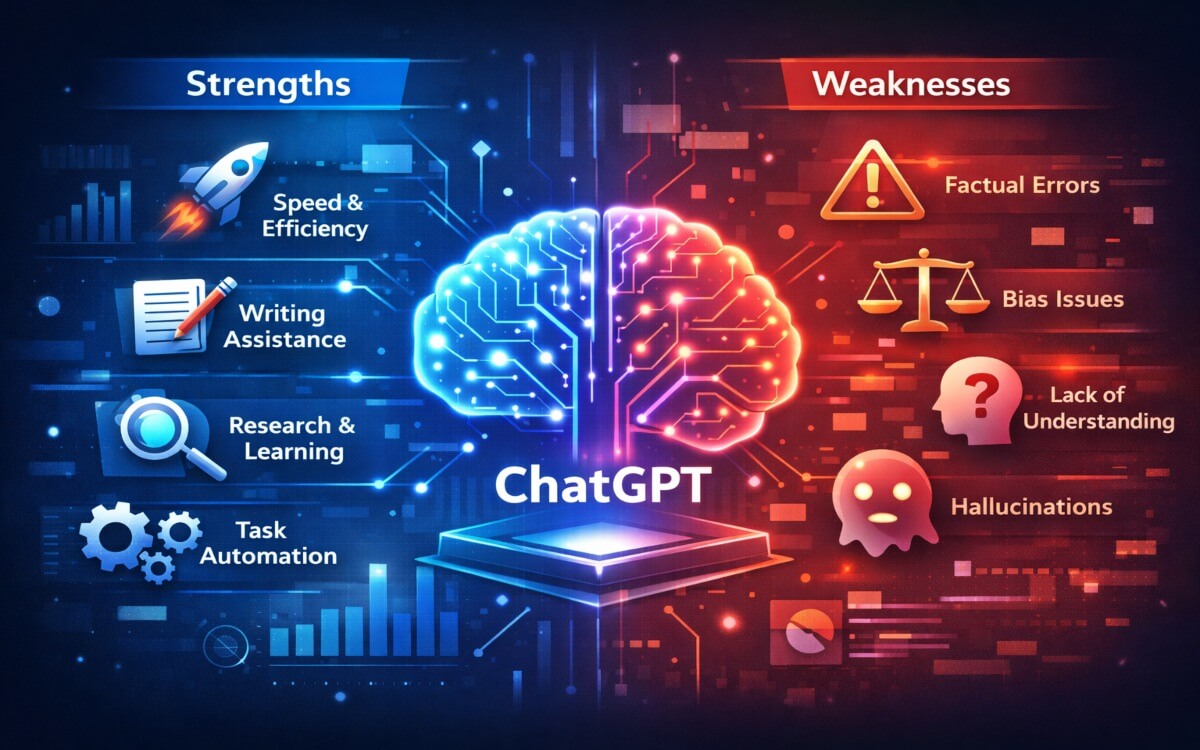
Few technologies arrive quietly, and ChatGPT certainly didn’t. Within months, students used it for assignments, businesses leaned on it for content, and educators worried about its impact. Suddenly, one question mattered more than hype: what are ChatGPT strengths and weaknesses?
Understanding both sides helps you use the tool wisely instead of blindly trusting it.
What ChatGPT Actually Is (And What It Isn’t)
At its core, ChatGPT is a large language model trained on massive text datasets.
It predicts words based on patterns, not understanding. That distinction matters more than most people realize.
- ChatGPT doesn’t think.
- It doesn’t know facts.
- It generates responses that sound right.
That’s both its magic and its flaw.
Key Strengths of ChatGPT
Speed That Changes How Work Gets Done
Time is usually the bottleneck. ChatGPT removes it.
You can draft emails, outlines, summaries, or ideas in seconds instead of hours.
For example, marketers use it to brainstorm headlines, while developers generate quick documentation. Used well, it acts like a productivity multiplier.
Strong Language and Writing Support
Struggling with clarity or tone? ChatGPT shines here.
It rewrites awkward sentences, improves flow, and adapts language for different audiences.
Non-native English writers, in particular, gain a powerful assistant that helps polish ideas without rewriting them from scratch.
Learning and Research Assistance
When you ask the right questions, ChatGPT becomes a patient tutor.
It explains complex topics, breaks down theories, and offers examples without judgment.
Students often use it to understand concepts before opening textbooks—not as a shortcut, but as a guide.
Business and Automation Use Cases
From customer support scripts to SEO content frameworks, businesses use ChatGPT to scale routine thinking.
According to OpenAI, companies integrate it to reduce repetitive tasks and free humans for strategic work.
Major Weaknesses of ChatGPT
Accuracy Isn’t Guaranteed
Here’s the uncomfortable truth: ChatGPT can sound confident and still be wrong.
This phenomenon, known as hallucination, happens when the model invents details that don’t exist.
Ask for citations, and you might get sources that look real—but aren’t.
No Real-World Understanding
ChatGPT doesn’t experience reality.
It can describe emotions, ethics, or consequences, yet it lacks lived context.
That’s why it struggles with nuanced judgment, cultural sensitivity, or moral reasoning in complex situations.
Academic Integrity and Misuse Concerns
Schools worry—and not without reason.
Students can misuse ChatGPT to generate essays without learning the material.
This has forced institutions to rethink assessment methods rather than simply banning AI
Data Limitations and Bias
ChatGPT’s knowledge depends on its training data.
If the data contains bias, gaps, or outdated information, those flaws appear in responses.
It also lacks access to real-time events unless explicitly connected to live data sources.
ChatGPT Strengths and Weaknesses Compared
| Strengths | Weaknesses |
| Fast content generation | Can hallucinate facts |
| Excellent language fluency | No true understanding |
| Helpful learning assistant | Ethical misuse risks |
| Scales repetitive tasks | Bias from training data |
This contrast explains why ChatGPT works best as a support tool, not a decision-maker.
Real-World Use Cases: When ChatGPT Works Best—and When It Doesn’t
ChatGPT excels when tasks involve patterns, drafts, or ideation.
It struggles when accuracy, accountability, or human judgment matters.
For example, using ChatGPT to outline a blog saves time. Using it to diagnose medical conditions invites disaster.
Context defines usefulness.
How to Use ChatGPT Smartly
- Treat ChatGPT like a junior assistant, not an authority.
- Verify important information.
- Refine prompts.
- Edit outputs critically.
When humans stay in control, ChatGPT becomes powerful rather than risky.
The Future Outlook: Tool, Threat, or Teammate?
AI won’t replace thinking humans.
It will replace humans who refuse to think alongside tools.
As regulations evolve and models improve, the real advantage will belong to users who understand both the strengths and weaknesses of ChatGPT—and act accordingly.
The Balanced Truth About ChatGPT
ChatGPT isn’t magic, and it isn’t dangerous by default.
It’s a mirror of how we use technology: thoughtfully or carelessly.
Used wisely, it accelerates learning, creativity, and productivity.
Used blindly, it spreads errors with impressive confidence.
The difference isn’t the tool.
It’s the user holding the keyboard.
This analysis reflects current research on large language models, including documentation from OpenAI and reporting from education, technology, and healthcare publications.
FAQs
1. What are the main strengths of ChatGPT?
ChatGPT excels at generating fast, coherent text, summarizing information, brainstorming ideas, and assisting with repetitive tasks. Its speed and adaptability make it useful across education, business, and research.
2. What are the biggest weaknesses of ChatGPT?
ChatGPT can produce inaccurate or fabricated information, lacks real-world understanding, and may reflect bias from its training data. It should never replace expert judgment or verified sources.
3. Is ChatGPT reliable for professional or academic work?
ChatGPT can support drafting and ideation, but professionals must verify facts independently. Overreliance can lead to errors, especially in medical, legal, or academic contexts.
Leave a Reply