
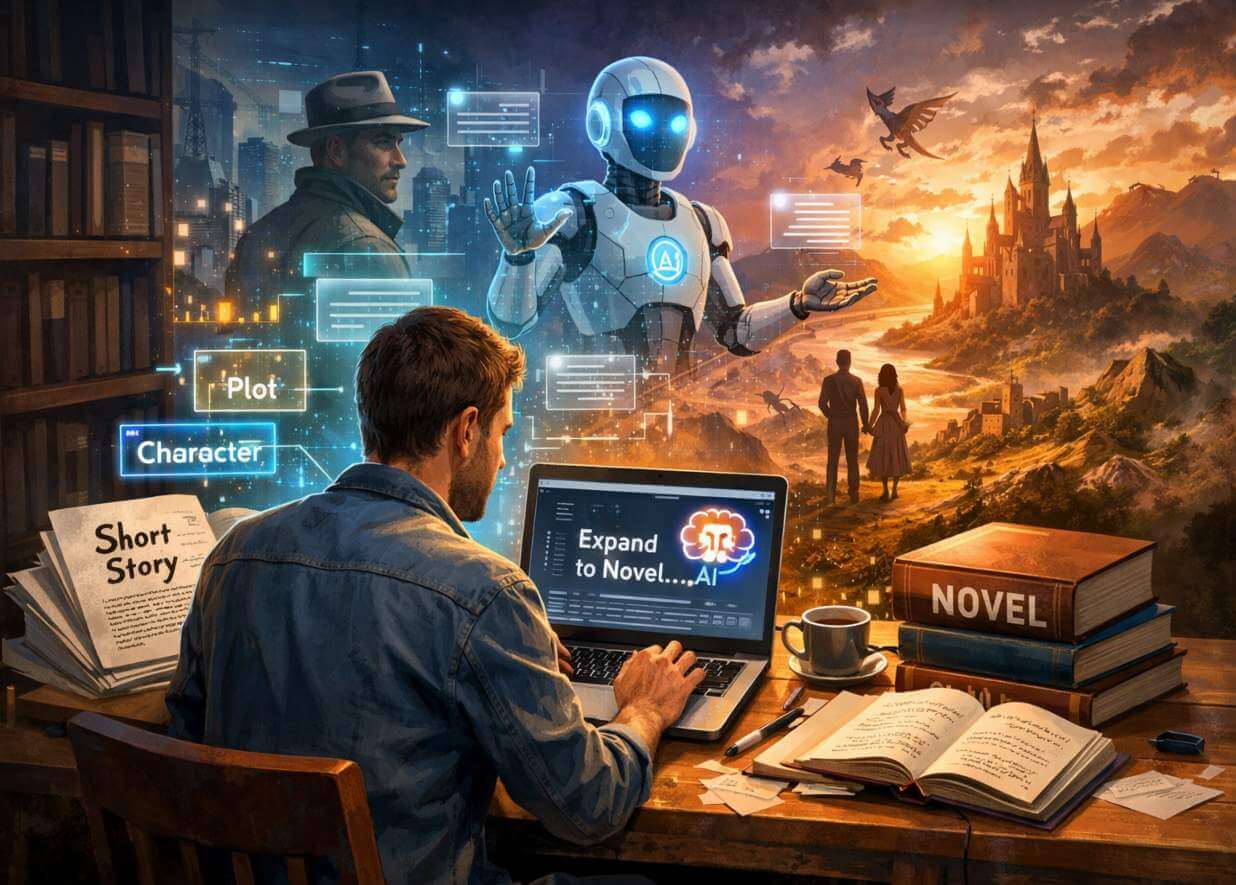
Deciding to expand a short story into a novel is one of the most exciting creative leaps a writer can make. It’s not about stretching thin material until it snaps. It’s about going deeper into a world that already has roots. Think of your short story as a snapshot. Your novel is the full-length film it was always meant to be.
I’ve been through this process myself, and I’ll be honest: the first time I tried it, I got it badly wrong. I added scenes just to hit a word count. Nothing connected. Nothing breathed. The second time, I slowed down, asked better questions, and used AI tools for writing to help me find what was already hiding in my draft. That version became a real book.
Whether you’re turning a short story into a full-length novel for the first time or you’ve tried before and stalled out, this guide walks you through the whole process, step by step, with practical AI prompts you can use right now.
TL;DR: What You’ll Learn in This Guide
- How to take your short story apart and figure out where it fits in a larger narrative
- Ways to deepen your characters so they can actually carry a novel
- How to build subplots and raise stakes without losing your story’s core
- Using AI tools to draft scenes, build outlines, and spot problems early
- Revision strategies that pull everything together into one cohesive book
What It Really Means to Expand a Short Story into a Novel
Let’s start with the mindset shift, because it’s the most important thing.
When most writers first try to adapt a short story into a novel, they think about word count. They ask: how do I get from 5,000 words to 80,000? That’s the wrong question. The right question is: what does this story need in order to be fully told?
Those two questions lead you to completely different places.
- Developing a short story into a novel means enriching it.
- You’re adding layers, not filler.
- You’re giving characters room to grow, giving the world room to breathe, and giving the central conflict the depth it needs to hold a reader’s attention across hundreds of pages.
Some of the most beloved novels started exactly where you are right now. Ender’s Game began as a novella. Flowers for Algernon was first published as a short story in a science fiction magazine. What those authors recognized was that they hadn’t actually finished the story. They’d only written its outline.
Your short story might be a powerful opening act. Or a climax with no buildup. Or a moving epilogue that needs everything that came before it. Once you figure out what role it plays, you’ll know what to build around it.
Six Steps to Expand a Short Story into a Novel
Step 1: Deconstruct Your Original Draft
Before you write a single new word, pull your short story apart at the seams.
- Read it slowly, like you’re reading someone else’s work for the first time.
- Take notes.
- Where does the tension live?
- What questions does it raise that it never answers?
- Which characters show up briefly and then disappear?
- What happened before the first line?
- What happens after the last?
I call these moments ‘plot doors.’
- They’re places where the story gestures at something bigger but doesn’t follow through.
- A character mentions a falling-out with their brother.
- A war is referenced but never explained.
- A place is described in one line when it deserves a whole chapter.
Those are your expansion opportunities.
Map them out. List every unanswered question, every hint at off-page history, every side character who could carry more weight. You’ll probably end up with more material than you expected. Most short stories, when examined this way, are already full of novel-sized ideas waiting to be developed.
Use AI to Analyze and Annotate Your Short Story
This is where AI tools become genuinely useful. Paste your short story into an AI writing tool and run these prompts:
- ‘Summarize the central conflict, stakes, and theme of this story.’
- ‘What questions does this story raise but leave unanswered?’
- ‘Which scenes could be expanded into full chapters? What events might logically happen before or after each one?’
- ‘What off-page events are implied but never shown?’
When I did this with one of my own drafts, the AI flagged a backstory element I’d thrown in as flavor text and pointed out that it contradicted itself across two scenes. I’d read that draft a dozen times and never caught it. Fresh eyes, even artificial ones, notice things you’ve stopped seeing.
Use the output as raw material. Not every suggestion will fit your vision, but you’ll find threads worth pulling.
Step 2: Deepen Your Characters and Cast
Short stories can survive on a lean cast. A novel cannot.
Readers spend weeks, sometimes months, inside a novel. The characters they meet there need to feel real enough to justify that investment. One-dimensional characters who exist to serve a plot function will sink a novel every time.
Go back to your protagonist and push past what you already know about them.
- What do they want more than anything?
- What are they terrified to admit?
- What lies do they tell themselves that keep them stuck?
- What would break them completely, and what would that moment look like?
Then look at your secondary characters. In the short story, they probably each did one job. In the novel, give them their own goals and contradictions. Consider adding new faces too: a mentor who pushes the protagonist in unexpected directions, a rival who reflects their worst qualities back at them, a love interest who complicates everything. Each new character should create new friction, not just a new company.
AI Prompts for Character Backstories and Arcs
AI is surprisingly good at generating character depth when you give it the right context. Here are prompts that have worked well for me:
- ‘Based on this character from my story, write a detailed backstory explaining their core motivation and their biggest fear.’
- ‘What long-term arc could this character follow across a 300-page novel?’
- ‘What contradiction or flaw in this character could create sustained conflict over multiple chapters?’
- ‘How might this character change from the beginning to the end of a novel-length story?’
One rule I always follow: paste your original short story into the conversation first, before you run any character prompts. That way, the AI works from your material, not its own assumptions. It’ll keep suggestions consistent with the voice and world you’ve already built.
Still, revise everything the AI gives you. Use it as a first draft of ideas, not a final answer.
Step 3: Expand the World and Central Conflict
Short stories often live in a tight frame. One location, one afternoon, one confrontation. That economy is part of what makes them work. But expanding a short story into a novel means widening the frame.
Ask yourself what exists outside the edges of your story.
- What’s the history of the world your characters live in?
- What are the social rules, the cultural tensions, the geography?
The more textured and specific your world becomes, the more pressure it puts on your characters, and the more interesting your conflict gets.
The central conflict itself needs to scale up, too. If the stakes in your short story were personal and immediate, think about how to make them bigger without making them generic. A character fighting to save their marriage is compelling. A character fighting to save their marriage while their entire industry collapses around them is even more so. Raised stakes aren’t louder versions of small stakes. They’re deeper ones, with more layers of consequence.
Brainstorm Subplots and New Conflicts With AI
Subplots are what give novels their texture. But they have to earn their place.
Every subplot you add should either complicate the main goal or reveal something new about a character. If it does neither, it’s dead weight. Cut it before it drags the whole book down.
Here’s a prompt that’s helped me find good subplots:
‘Given this main conflict and cast of characters, suggest five subplots that would create meaningful complications without pulling focus from the central story.’
When I ran this for a recent project, I got a betrayal arc I hadn’t considered, a secondary mystery that tied directly into my main theme, and a quiet friendship storyline that gave my protagonist somewhere to be vulnerable. Two out of five made it into the book. That’s a solid hit rate for a five-minute brainstorm.
Tips for expanding short fiction into subplots that actually work:
- Connect every subplot to your central theme
- Make sure each subplot affects at least one major character’s arc
- Give subplots their own mini arc: setup, complication, resolution
- Introduce subplots early enough that they feel planted, not dropped in
Step 4: Adjust Pacing and Structure for a Novel
Short stories are sprints. Novels are marathons. And if you run a marathon at sprint pace, you’ll collapse somewhere around chapter seven.
The most common pacing mistake I see in expanded short stories is that everything happens too fast. Characters don’t have time to process what’s happened to them. Scenes end before the emotion can land. The world rushes by without giving the reader a chance to settle into it.
Novel pacing is about ebb and flow. Tension rises, then it releases. A high-stakes confrontation is followed by a quieter scene where characters reckon with what just happened. Then the pressure builds again. That rhythm is what keeps readers turning pages without burning out.
Pick a structure framework and use it as your skeleton. The three-act structure works well for most genres. The Save the Cat beat sheet is excellent if you like granular breakdowns. Neither one is a cage. They’re scaffolding. Once the structure is up, you can fill it in however you want.
If you’re unfamiliar with foundational narrative structure models, resources like the Purdue Online Writing Lab offer clear breakdowns of plot and structural frameworks.
Turn Your Short Story into a Beat Sheet With AI
Here’s the practical workflow I use when I’m using story expansion techniques for a novel outline.
First, list the key beats in your short story: the opening image, the inciting incident, the midpoint, the darkest moment, the climax, the resolution. Write them out in plain language, one sentence each.
Then give that list to an AI tool with this prompt: ‘Here are the major beats from my short story. I’m expanding it into a novel. Suggest 12 to 15 additional beats, scenes, and transitions that would fit naturally around these.’
You’ll get a rough beat sheet for the whole novel. It won’t be perfect, and you’ll probably rearrange half of it. But having something to react to is infinitely easier than staring at a blank page. Trust me on this one. I’ve tried both approaches, and the beat sheet wins every time.
Step 5: Drafting New Scenes with AI Support
You have your structure. You know your characters. Now you actually have to write the thing.
New scenes are often the hardest part of expanding a short story into a novel. You don’t have the energy of that original creative burst. You’re building in gaps, between events you’ve already written, and the seams can show if you’re not careful.
AI can help you get unstuck here. Use it to generate first drafts of scenes you’re dreading: the backstory confrontation, the subplot introduction, the quiet moment that sets up the big twist. Give it your original story for context, describe the scene’s purpose, and ask for a draft. Then rewrite that draft in your own voice.
I think of it like sketching before you paint. The AI gives me a rough outline of where things should go. Then I come in and do the real work on top of it.
Focus especially on scenes that:
- Dramatize backstory that was only mentioned in the short story
- Introduce new characters and establish who they are
- Show the world beyond the narrow frame of the original draft
- Give characters quiet moments to reflect so the emotional beats land harder later
Keep the Story Cohesive: Voice, Theme, and Continuity
Here’s something nobody warns you about when you start expanding short fiction into a novel: the voice drifts.
You write chapter one with one energy. Six months later, you write chapter fifteen with a different energy. By the time you’re done, the book can feel like it was written by three different people, which, in a way, it was.
The fix is a story bible. Create a simple document that tracks your character profiles, world rules, timeline, and key theme. Keep it updated as you write. When you use AI to draft scenes, paste the relevant parts of your bible in as context so the suggestions stay anchored to what you’ve already built.
And always, always tie new material back to your central theme. That theme is the spine of the book. If a scene doesn’t connect to it, even obliquely, ask yourself why it’s there.
Step 6: Revision: From Expanded Draft to Cohesive Novel
You’ve written the expanded draft. Good. Now set it aside for at least a week if you can, then read the whole thing from page one like you’re a reader who just picked it up.
Your goal in revision is to make the book feel like it was always a novel, not like a short story with chapters stapled onto it.
Run these passes in order:
- Character consistency pass: Does each character behave in a way that tracks with their backstory and arc? Do they grow believably?
- Plot continuity pass: Are there timeline issues? Does anything contradict something you established earlier?
- Pacing pass: Are there sections that drag? Places where the tension never releases? Scenes that feel repetitive?
- Theme pass: Does every subplot connect back to the central theme? Does the ending pay off what the opening set up?
AI can help with developmental editing too. Paste in a chapter and ask: ‘Does this scene serve the main plot or a meaningful subplot? Does anything feel off about the pacing or character behavior? Are there any continuity issues?’ You won’t take every suggestion, but a second pass from a fresh perspective almost always surfaces something worth fixing.
Examples and Case Studies
Real examples make this process concrete, so let’s look at two.
Ender’s Game started as a short story published in 1977. When Orson Scott Card expanded it, he didn’t just add scenes. He built an entire school system, deepened a cast of dozens, and embedded the story in a complex political world that made the climax hit completely differently. The short story was essentially the ending. The novel built everything that gave that ending meaning.
Flowers for Algernon went through a similar transformation. The short story told Charlie’s arc in compressed form. The novel gave readers time inside Charlie’s mind as it changed, introduced relationships that made his rise and fall personal, and let the emotional truth land with far more weight. The expansion didn’t dilute anything. It amplified everything that already worked.
When I look at my own short stories now, I ask one question first: what happened before the opening line, and what happens after the last? The answers to those two questions are usually the novel.
Common Mistakes When Expanding a Short Story into a Novel
I’ve made most of these mistakes myself, so take them seriously.
- Padding instead of developing. If you’re adding scenes just to hit a word count, readers will feel it. Every chapter needs a reason to exist.
- Subplots that go nowhere. A subplot that doesn’t connect to the main theme or affect a character’s arc is dead weight. Don’t fall in love with your ideas. Cut the ones that don’t pull their weight.
- Losing the emotional core. Your short story had a tight, powerful truth at its center. The novel should make that truth fuller, not fainter. If the expansion feels like it’s diluting what made the original good, pull back.
- Overexplaining everything. Novels have more room than short stories, but that doesn’t mean you should use all of it. Selective depth is stronger than comprehensive coverage.
- Skipping the outline. Drafting without a structure almost always creates a sagging, directionless middle. Build the beat sheet before you start writing new scenes.
Final Thoughts
Expanding a short story into a novel is one of the most rewarding things you can do as a writer. Not because it’s easy. It isn’t. But because you’re taking something that already matters to you and finding out how deep it actually goes.
Your short story has a DNA. The characters, the conflict, the world, they’re all already encoded in what you’ve written. The novel is what happens when you follow that code all the way down.
AI tools can be a genuine partner in this process. They help you analyze what you’ve written, build character depth, generate scene drafts, and spot inconsistencies you’ve gone blind to. But they work best when you stay in the driver’s seat. The story is yours. The AI just helps you see more of it.
So if you’ve got a short story sitting in a drawer that feels bigger than it looks, don’t ignore that feeling. Start with Step 1. Pull it apart. See what’s hiding inside.
You might be surprised by what you find.
Got a short story you’re thinking of expanding? Share your word count, genre, and biggest challenge in the comments below. And for more resources on AI-assisted writing and story development, head over to ustoai.com.
FAQs
1. Can any short story be expanded into a novel?
Not every short story has enough conflict or thematic depth to support a full novel. Some pieces are already complete at their natural length, and forcing them longer will only weaken them. Before you commit to the expansion, look closely at your story for signs that there is more to tell. Does it suggest untold backstory? Are there off-page events that shaped the characters in ways the story never shows? Do unanswered questions linger after the final sentence? If the answer to those questions is yes, you likely have a story worth growing. If the story feels genuinely finished as it stands, trust that instinct and start something new instead.
2. How long should my novel be after expanding a short story?
Most adult novels land somewhere between 70,000 and 100,000 words, though genre expectations shift that range considerably. Thrillers and literary fiction tend to sit closer to 80,000. Fantasy and science fiction often run longer. Romance novels can sell closer to 50,000. The honest answer is that the right length is whatever it takes to tell your story completely without padding it. Focus first on building a full, satisfying narrative arc with a real beginning, middle, and end. Then look at length during revision and trim or develop from there.
3. How can AI help me expand a short story without losing my voice?
The key is using AI for idea generation and rough drafting rather than finished writing. AI is good at brainstorming backstories, suggesting subplots, generating scene drafts, and flagging continuity issues. It is not good at replicating the particular rhythm and sensibility that makes your writing sound like yours. So use AI as a starting point, then rewrite everything it gives you in your own words. Also, feed your original short story to the AI before running any prompts. When the tool has your actual material to work from, its suggestions stay much closer to the tone and world you have already built.
4. What are the biggest mistakes writers make when turning a short story into a novel?
The most common mistake is adding scenes that do not actually change anything. Filler scenes inflate word count but drain momentum, and readers feel the drag even if they cannot name it. The second most common mistake is introducing subplots that never connect back to the main story or the central theme. A disconnected subplot is a detour your reader never asked for. The third mistake is letting expansion dilute the emotional core that made the short story work in the first place. Every chapter you add should either raise the stakes, deepen a character, or move the plot forward. If it does none of those things, it does not belong in the book.
5. Should I start by outlining the novel or just keep drafting from the short story?
Outline first. Most experienced writers and writing coaches recommend stepping back to build a multi-act structure before you start drafting new scenes. You need to see the whole shape of the expanded story before you can know where new scenes, subplots, and turning points belong. Once you have that outline, you can place your original short story inside the larger structure, often as a midpoint sequence, a climax, or a key second-act scene, and build outward from there. Writers who skip the outline and draft directly tend to end up with a sagging, directionless middle section that costs them weeks of revision to fix.
Leave a Reply