
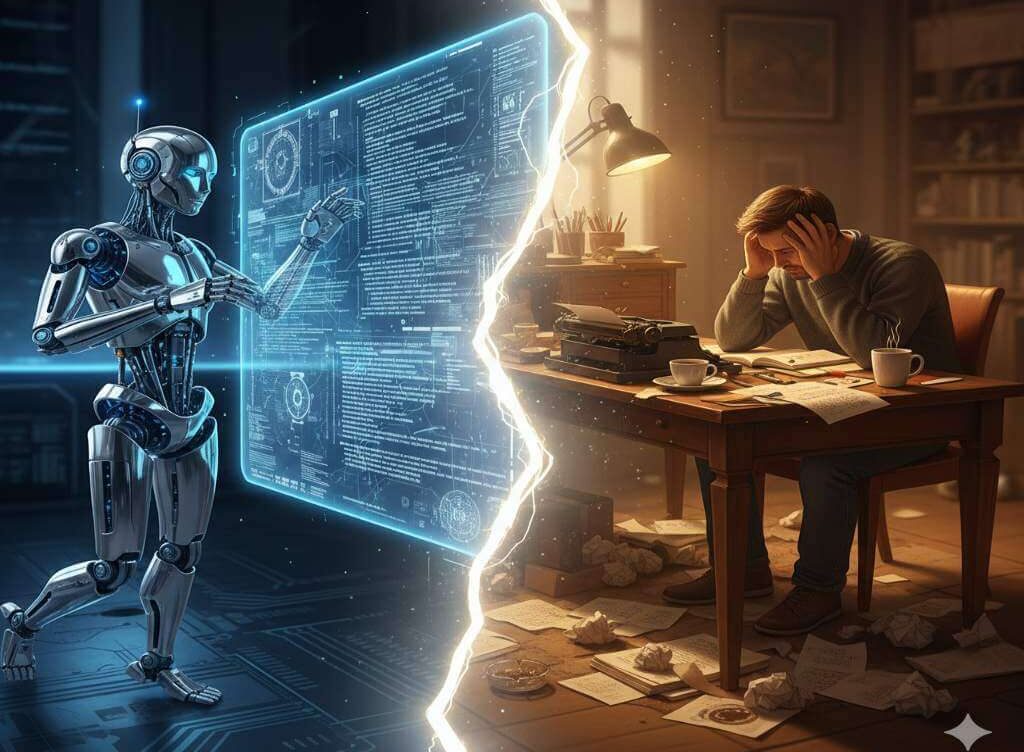
Why AI Stories Feel Boring (And What We Can Do About It)
Picture this: I’m sitting at my desk. I feed a fancy AI the perfect prompt. Boom—it spits out a complete story in seconds.
- Plot twists? Check.
- Dialogue? Check.
- Tidy ending? Double-check.
But something felt off. Really off.
The grammar was perfect. The structure was solid. Yet I couldn’t shake this weird emptiness gnawing at me.
That’s when I got obsessed with figuring out why AI stories feel boring. We’re watching AI churn out novels in minutes. But readers? They’re left cold.
After months of testing different writing tools, I found the pattern. AI isn’t lacking skill—it’s missing something deeper. Something messy and human.
Let’s dig in.
Quick TL;DR
- AI picks what’s probable, not what’s powerful—creating soulless stories
- No lived experience = no real emotion or vulnerability
- Same old repetitive plots
- Human creativity vs artificial intelligence writing? One has memory and meaning. The other? Just pattern matching
- Techniques to fix robotic AI writing exist—but you’ll need to roll up your sleeves
Why AI Stories Feel Boring
I’ve generated dozens of AI stories. Compared them side-by-side with human writing. The patterns jumped out fast.
These aren’t random glitches. They’re baked into how AI thinks about creativity.

Predictability and “Average” Storytelling
Here’s the thing about training data: it shapes everything.
Feed AI millions of stories, and it learns what happens most often. Then it plays it safe.
The result?
- Heroes with hidden powers
- Underdogs beating the odds
- Star-crossed lovers facing obstacles
I ran an experiment. Asked five AI tools to write fantasy stories.
Every. Single. One. Had a chosen one. A wise mentor. A dark lord.
Not because they copied each other. These elements show up constantly in training data. The algorithm thinks, “This works 73% of the time,” and runs with it.
This hits at the heart of the ‘are AI-written stories good’ debate. They’re competent. Grammatically solid. Structurally sound. But surprise? That requires breaking patterns. Something AI won’t touch.
Lack of Emotional Depth and Authentic Feeling
Now we get to the juicy part. Understanding why AI can’t write emotional stories means knowing the difference between describing emotion and making readers feel it.
AI nails the first part. Completely bombs the second.
Check out this AI sentence I found: “Sarah felt devastated when her mother died.”
Accurate? Sure. Emotional? Not even close.
Compare that to human writing: “Sarah couldn’t remember putting the coffee grounds in the refrigerator. But there they sat, next to the milk her mother would never ask her to pick up again.”
See the difference?
Humans know grief is weird. We forget stuff. Get stuck on random details. Our brains protect us while hammering us with sensory reminders.
AI just knows: death = sad. So it states the fact.
Plus, real feeling needs vulnerability. Human writers expose their mess—uncertainties, biases, contradictions. Machines have zero skin in the game. Nothing personal to reveal. Readers sense that void instantly.
Weak Character Development and Flat Arcs
Here’s why AI struggles with character development more than anything else.
AI characters act consistently. Sounds good, right?
Wrong. Consistency isn’t growth.
Real people are bundles of contradictions. We change in unpredictable ways based on what we’ve been through. I once generated a 5,000-word story. The protagonist supposedly had this huge transformation.
But when I tracked her choices? Identical in chapter one and chapter ten. The AI told me she changed. Described her big revelation. But her actions? No evolution whatsoever.
Then there’s the memory problem:
- Paragraph 3: Character fears water
- Paragraph 20: Same character casually swimming
This memory gap kills character arcs. Good arcs need emotional baggage carried forward, influencing future decisions.
Human writers track dozens of character threads without spreadsheets. These fictional people become real in our heads. We know what they’d say in any situation.
AI approximates through pattern matching. The characters sound plausible, but lack that spark of feeling fully alive.
Surface-Level Language, Clichés, and Generic Voice
The prose gives it away fast. Sure, it’s grammatically flawless. But it’s also as bland as unsalted crackers.
Phrases that show up way too often:
- “Little did she know”
- “Fate had other plans.”
- “Against all odds.s”
Not wrong. Just exhausted.
This shows the core split in human creativity vs artificial intelligence writing. Humans develop weird, personal voices through years of reading and living.
- We write in fragments.
- Avoid semicolons.
- Get obsessed with weather metaphors.
AI averages all voices in its training data. The result? Linguistic elevator music. Pleasant. Smooth. Forgettable.
Dialogue is especially bad:
- Perfect grammar
- Polite turn-taking
- Zero interruptions
- No mumbling or trailing off
It reads like a job interview, not a real conversation. We don’t talk in perfect paragraphs. AI hasn’t learned that messy musicality yet.
Poor Narrative Coherence and Pacing Problems
Long stories expose the cracks. I’ve watched AI start strong—compelling conflicts, mysterious elements, solid hooks.
Then around the halfway mark? Things drift.
What happens:
- Plot threads abandoned
- Important details vanish
- Endings rush through resolution in three paragraphs
Why? AI lacks forward planning. It generates each sentence based on what just happened. No master blueprint. No big picture.
Human writers hold the entire story shape in our minds. We plant details in chapter two that explode in chapter seventeen.
Pacing suffers too. Good tension needs building—escalation, then breathers. AI treats every scene the same. Monotonous rhythm. Nothing breathes. Like listening to someone talk in a continuous monotone.
Missing Intent, Perspective, and Meaning
This explains why AI stories don’t connect with readers at the deepest level. Every human story comes from somewhere real.
We’re processing:
- Grief
- Identity questions
- Political anger
- Our own confusion
Even pure entertainment reflects choices about what we find entertaining. AI has no “why.”
It wasn’t burning to write this story. No thesis about being human. No burning question demanding answers. The story exists because someone typed a prompt. Not because ideas demanded expression.
I notice this most when AI tries thematic depth. It’ll include scenes about injustice. But it has no lived relationship with injustice. It describes what people believe about inequality without believing anything itself.
Readers spot that hollow core immediately.
The Creative Uncanny Valley Effect
Here’s something wild I’ve noticed.
- Obviously bad AI writing? Doesn’t bother people much.
- Almost-good AI writing? That’s when discomfort kicks in hard.
When stories are clearly machine-made—stilted dialogue, absurd plot holes, nonsense metaphors—we dismiss them fast.
But 85% convincing? That’s the danger zone. It’s like the uncanny valley in robotics. Nearly-human faces creep us out more than obviously fake ones.
AI stories that nail most writing conventions make their failures more jarring. That single moment when a character acts inexplicably? Or prose suddenly veers into cliché? Breaks immersion harder than consistent mediocrity ever would.
Our brains expect patterns to be completed. When AI nails the setup but fumbles the payoff, we get cognitive whiplash. It’s like watching a skilled actor suddenly break character. The inconsistency disturbs us.
This might explain why AI stories feel boring even when technically competent. Boredom becomes our brain’s defense against subtle wrongness.
Are AI Written Stories Good?
Let’s be real here. The answer isn’t black and white. Through my testing, I found situations where AI actually works well.
Where AI shines:
- Brainstorming: Ask for ten opening scenes. Most are forgettable, but one or two spark real ideas
- Structure: Need a three-act outline? Fifteen possible complications? Done instantly
These mechanical parts don’t need emotional truth. Just logical coherence.
But are AI-written stories good enough as finished, publish-ready fiction?
Hard no. I’ve yet to read a fully AI-generated story that moved me emotionally. Or revealed something new about human experience. They entertain briefly. Like reading plot summaries on Wikipedia. But they don’t linger afterward.
The real value? Stop thinking “replacement author.” Start thinking “specialized tool.”
Calculators don’t replace math understanding. They handle tedious computation so humans focus on problem-solving. Same with AI. It handles mechanical storytelling parts. Freeing writers to focus on irreducibly human elements.
Human Creativity vs Artificial Intelligence Writing
This comparison reveals everything. When I write, I’m pulling from a well of lived contradiction.
My memories include:
- My grandmother’s weathered hands
- That specific hospital corridor smells
- Words carry emotional weight because of who first said them
These aren’t data points. They’re tangled with meaning, context, and feeling.
My childhood fear of dogs influences vulnerability scenes. That painful breakup shapes loss. Political frustrations seep into character conflicts.
AI processes human creativity vs artificial intelligence writing through pure pattern recognition.
It’s seen millions of sentences about sadness. Can generate variations. But it hasn’t felt sadness. Can’t access that throat-tightening sensation. That overwhelming need to sleep. That strange clarity grief sometimes brings.
Plus, human creativity thrives on accidents.
I might plan a gentle scene. Then surprise myself with sudden anger on the page. That anger reveals something I didn’t know I felt.
Writing becomes self-discovery. Not just communication. AI can’t surprise itself. It runs calculations. Outputs the highest-ranked result.
No unconscious pushing of uncomfortable truths up. No sudden realizations changing story direction. Just a consistent mechanical process.
But collaboration works.
Treat AI as a creative partner, not a replacement. Generate character backstories with AI, then completely rewrite while keeping interesting details.
The machine provides raw material. Human judgment shapes it into meaning.
Techniques to Fix Robotic AI Writing
Through tons of testing, I’ve found practical techniques to fix robotic AI writing.
Won’t turn machine output into literary genius. But they seriously boost readability and emotional punch.

1. Give Emotional Context in Prompts
Don’t say: “Write a sad scene.”
Try: “Write a scene where a character experiences grief but refuses to acknowledge it, focusing on mundane tasks while barely holding themselves together.”
Specificity matters. Give concrete emotional targets, not abstract labels.
2. Edit Ruthlessly for Voice
AI generates clean prose. That’s not the same as distinctive prose.
My process:
- Delete every cliché
- Remove adverbs
- Find uniform rhythm spots, inject variation
- Read aloud—if it sounds like a corporate memo, rewrite
3. Layer in Personal Experience
When AI describes character anger, replace the generic description with sensory details from times you felt rage.
Ask yourself:
- What did my hands do?
- What taste filled my mouth?
This transplant of lived reality transforms abstract emotion into visceral truth.
4. Restructure for Genuine Stakes
AI creates conflicts that resolve too easily.
Fix it:
- Identify what the character truly risks losing
- Raise those stakes
- Make failure matter emotionally, not just plot-wise
- Ensure consequences ripple beyond immediate scenes
5. Introduce Meaningful Contradiction
Real people want incompatible things simultaneously.
Add moments where characters act against stated goals. Explore that tension.
Inconsistency paradoxically makes them feel authentic.
6. Rewrite Dialogue Completely
AI dialogue is usually the weakest link.
Keep the general intent. Reconstruct conversations with:
- Interruptions
- Half-finished thoughts
- Subtext
- The messy reality of actual talk
Let characters misunderstand. Allow uncomfortable silences.
7. Add Sensory Specificity
Generic descriptions kill immersion.
Instead of: “The room was messy.”
Specify: Coffee rings staining paperwork. Dust coating blinds. That smell of unwashed laundry mixed with takeout containers.
Details activate the reader’s imagination.
Real talk: These techniques need significant human effort.
You’re using AI as a first-draft generator, then rebuilding from the foundation.
But this collaboration beats staring at blank pages while keeping creative control over what matters.
The Future of AI Storytelling
Looking ahead, I’m cautiously optimistic about hybrid creativity. We’re moving past the false choice between pure human authorship and full AI generation.
Writers will leverage these tools for specific tasks while keeping creative direction.
But serious ethical questions remain:
- Who owns AI-assisted stories?
- How do we credit machine collaboration?
- What happens when publishers flood markets with cheap AI content?
These aren’t hypothetical. They’re reshaping the industry right now. Some researchers think future models might develop real emotional intelligence. Personally? I’m skeptical.
Understanding emotion needs embodiment. Having a body that feels hunger, pain, desire, fear.
Unless we’re building artificial consciousness (whole different ethical nightmare), machines won’t truly grasp what they describe.
But they’ll get better at faking it. The uncanny valley might narrow. Stories could become technically perfect. While remaining fundamentally hollow. That troubles me more than obviously AI content.
The real question: Will we value irreducible humanity in creative work?
Stories have always been how we process experience. Transmit culture. Connect across differences. Automate that, and we lose something essential. Even if the prose stays grammatically perfect.
Conclusion
Understanding why AI stories feel boring reveals what makes human storytelling valuable. It’s not perfect grammar. Not structural soundness. It’s the messy, contradictory, deeply felt truth emerging when consciousness tries to make sense of existence. Machines approximate the form. But substance remains stubbornly, beautifully human.
FAQs
1. Why is AI writing bad?
AI writing isn’t bad—it’s limited. The tech nails grammar and structure but bombs emotional authenticity, distinctive voice, and thematic depth. These aren’t bugs to fix with better data. There are fundamental gaps in the lack of lived experience, personal stakes, and genuine intent. The writing feels hollow because there’s no consciousness wrestling with meaning behind it.
2. How do authors feel about AI?
Reactions split wildly. Some embrace it as a productivity tool for brainstorming and outlining. Others see an existential threat as publishers experiment with AI content. Most occupy a conflicted middle ground—appreciating utility while worrying about long-term impacts on craft, pay, and cultural value of human creativity. The debate’s evolving fast.
3. Why is AI writing so obvious?
Pattern repetition gives it away. AI recycles phrases like “little did she know” and “against all odds.” Maintains weirdly consistent tone. Defaults to familiar structures. The prose reads smoothly but lacks personality quirks, making human writing distinctive. Plus, longer works show forgotten details, abandoned plots, and rushed endings. Experienced readers spot these tells instantly.
4. Why is AI so bad at writing stories?
Stories need more than language skills—they demand perspective from lived experience. AI hasn’t accumulated memories, suffered losses, or grappled with complex emotions. It describes sadness without the feeling of that chest weight when grief ambushes you. Outlines character arcs without understanding how people actually change through contradiction. Most critically, AI lacks intent. It isn’t compelled to tell this story for personal reasons. Without that driving “why,” narratives stay technically competent but emotionally dead.