
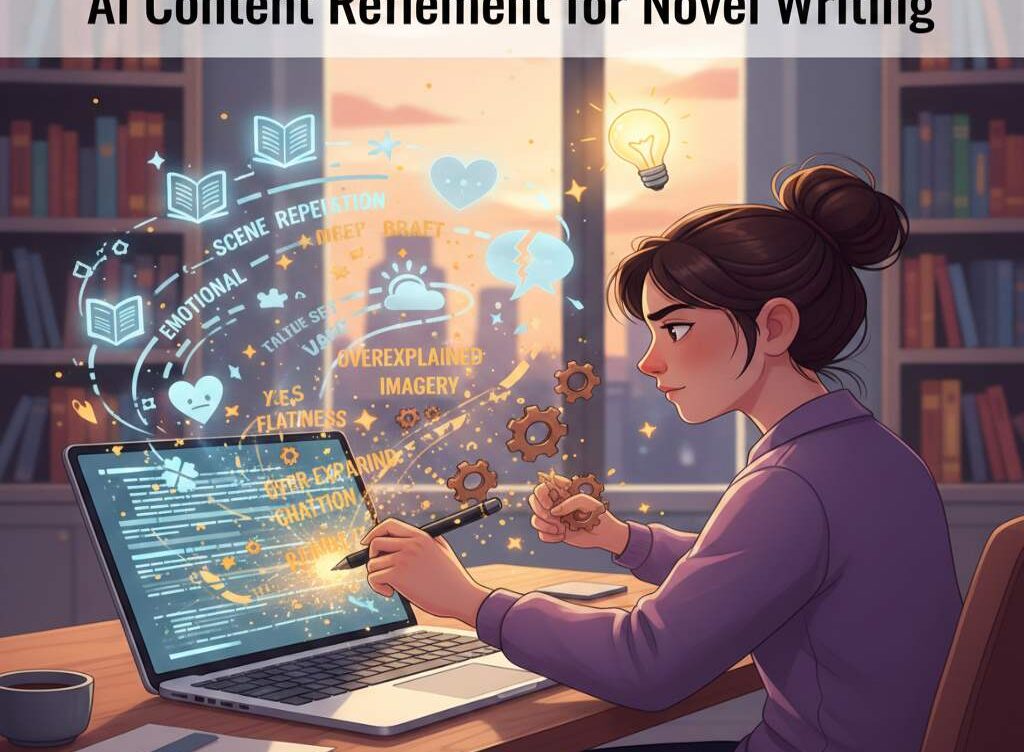
AI Content Refinement for Novel Writing: Turning Generated Drafts into Real Fiction
I’ve spent countless hours wrestling with AI-generated novel drafts, and I can tell you this: the machine gives you structure, but it rarely gives you soul. After working with hundreds of fiction manuscripts that started with ChatGPT or Claude, I’ve learned that AI content refinement isn’t optional—it’s the difference between a hollow draft and a story readers actually finish.
Let me walk you through what I’ve discovered about transforming AI-generated fiction into something worth reading.
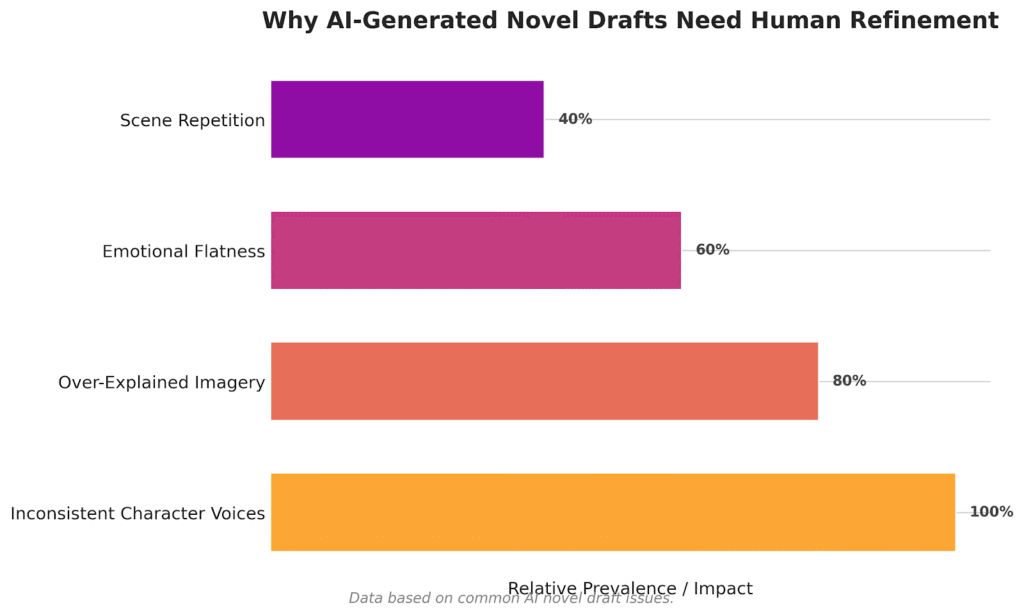
Why AI-Generated Novel Drafts Need Human Refinement
When I first experimented with AI for my thriller manuscript, I thought I’d found a shortcut. Instead, I found a new kind of problem.
- Scene repetition haunted every chapter. My protagonist would “furrow his brow” seventeen times in forty pages. The AI loved certain phrases so much it recycled them like a broken jukebox. One detective novel I edited had the phrase “tension hung in the air” appear in literally every interrogation scene.
- Then there’s emotional flatness. AI describes feelings rather than showing them. Your character doesn’t slam the door—they “felt angry and closed it forcefully.” The visceral punch gets replaced with clinical observation. I once read an AI-generated breakup scene that read like a therapist’s case notes instead of heartbreak.
- Over-explained imagery kills momentum faster than anything else. AI can’t resist telling you exactly what everything means. A sunset isn’t just crimson—it’s “a crimson sunset that symbolized the character’s fading hope.” Readers aren’t stupid. They don’t need every metaphor unpacked like IKEA furniture.
- Inconsistent character voices represent the deepest flaw. Your witty detective suddenly speaks like a philosophy professor mid-chapter. The teenage protagonist uses vocabulary that would make a literature professor proud. I’ve seen supporting characters completely change personality between scenes because the AI forgot who they were.
This is pure novelist pain. However, it’s also fixable with the right approach to AI text editing.
AI Content Editing for Novel Writing: Turning AI Drafts into Real Fiction
Let me be clear about something: AI content editing for novels isn’t about correcting typos or fixing comma splices. It’s about surgical intervention on narrative DNA.
Editing AI scenes without breaking plot continuity requires you to track every thread. I use a spreadsheet now. When you change how a character learns crucial information in chapter three, you can’t let them magically know it in chapter seven. AI generates scenes in isolation, forgetting what came before. Your job becomes continuity guardian.
Improving dialogue realism means reading every conversation aloud. Does your bartender really say, “I shall procure your beverage momentarily”? AI defaults to formal speech patterns that sound like everyone attended Oxford. Strip away the SAT vocabulary. Add interruptions, half-finished thoughts, and the messy way people actually talk.
Fixing “same-sentence syndrome” saved my sanity. AI loves symmetrical construction. “She walked to the door. She turned the handle. She stepped outside.” Every sentence becomes a three-beat march. Break the rhythm. Combine some actions, expand others, let sentence length breathe and contract like real prose should.
Preserving authorial voice represents your biggest challenge. AI has no voice—it mimics patterns. You need to rewrite key passages in your actual style, then let those serve as templates for the rest. I rewrote my first chapter completely by hand, then used it as a style guide for editing the AI-generated middle sections.
In novel writing, AI content editing isn’t about fixing grammar—it’s about restoring voice, tension, and narrative intent to AI-generated scenes. The AI writing quality improves dramatically when you treat the draft as raw material rather than a finished product.
AI Writing Revision vs Editing in Fiction: A Critical Distinction
Most writers confuse these terms, which leads to shallow fixes on deep problems.
Editing happens at the line level. You’re adjusting word choice, tightening sentences, and removing redundancies. When I edit AI fiction, I’m changing “She was feeling extremely sad” to “Grief hollowed her out.” It’s micro-level surgery.
Revision involves story-level thinking. Does this scene even belong here? Should this character arc bend differently? Revision asks whether Chapter Five needs to exist at all. AI writing revision might mean cutting three AI-generated chapters entirely because they stall momentum.
I spent weeks editing AI prose sentence by sentence, polishing every paragraph. Then I realized the entire second act was structurally broken. Beautiful sentences describing meaningless scenes.
AI draft polishing works in layers:
First pass: Fix obvious AI tells (repetition, flat emotion, over-explanation). Second pass: Deepen character consistency and voice. Third pass: Examine story structure and pacing. Fourth pass: Line-level professional AI editing for prose quality.
You can’t skip to the last step. I’ve seen writers publish beautifully worded novels with no emotional core because they only edited, never revised.

A Practical Post-AI Editing Workflow for Novelists
After refining this process across dozens of manuscripts, here’s what actually works:
Scene intent check comes first. For every AI-generated scene, I ask: what does this accomplish? If the answer is “it describes things” or “it moves characters from point A to point B,” that scene needs radical revision or deletion. Fiction isn’t a travelogue.
I keep a running doc titled “Scene Purpose.” Each entry looks like: “Chapter 7, Scene 2: Marcus discovers his partner’s betrayal through the encrypted files. Reader learns Marcus values loyalty above legality.” If I can’t write that summary, the scene doesn’t earn its place.
Character consistency scan requires you to track dialogue and behavior patterns. I create a voice document for each major character with their specific speech patterns, vocabulary level, and verbal tics. When editing AI dialogue, I reference these constantly. My detective says “Yeah,” not “Yes.” He interrupts people. He never finishes long explanations because his mind jumps ahead.
The emotional escalation pass examines whether feelings intensify appropriately. AI generates scenes at the same emotional temperature. Your protagonist can’t react to a parking ticket and a murder with identical intensity. I map emotional peaks and valleys across chapters, ensuring proper build and release.
Sensory detail enrichment addresses AI’s tendency toward visual-only description. Real scenes include sounds, smells, textures, and even tastes. I rewrite sterile AI paragraphs by adding sensory layers. “The warehouse was dark and empty” becomes “The warehouse reeked of motor oil and rust, its silence broken only by dripping water echoing off distant metal.”
This workflow transforms AI content editing from random fixes into systematic improvement.
Common AI Content Editing Mistakes in Novel Writing
I’ve made most of these errors myself, usually while trying to save time.
Publishing AI prose untouched ranks as the cardinal sin. I’ve seen authors release novels with obvious AI fingerprints—repetitive phrasing, emotional flatness, symmetrical sentence structures—thinking readers won’t notice. They notice. Amazon reviews mention “weird robotic prose” within days.
Letting AI control pacing destroys narrative momentum. AI treats every scene with equal weight, devoting the same word count to breakfast conversations and climactic confrontations. Your editing must shrink trivial scenes and expand crucial moments. I cut one AI-generated chapter from 4,000 words to 800 because it was just characters traveling with no story development.
Overusing AI metaphors creates unintentional comedy. AI loves comparing abstract concepts to nature and weather. “Her anger was like a storm.” “His thoughts were clouds.” “Their relationship was a garden.” These metaphors sound profound to algorithms but cliché to readers. Replace 90% of AI-generated metaphors with specific, surprising comparisons.
Trusting AI with emotional climax scenes represents dangerous overconfidence. I always rewrite climactic moments completely. AI can’t build to emotional peaks because it doesn’t understand catharsis, delayed satisfaction, or earned revelation. Your protagonist’s breakdown, the final confrontation, the moment of truth—write these yourself.
One fantasy author I consulted had used ChatGPT for her entire final battle. It read like a video game walkthrough: “The hero struck with his sword. The villain dodged. Magic energy crackled.” Zero emotional weight. We rewrote it, focusing on the protagonist’s internal conflict while the external battle raged around her. Night and day difference.
Conclusion
AI content refinement for novel writing demands more effort than most writers anticipate. You can’t just run ChatGPT output through Grammarly and call it ready to publish.
The drafts AI generates require systematic revision addressing scene purpose, character consistency, emotional escalation, and sensory detail. You’ll rewrite dialogue completely, break repetitive patterns, add subtext, and inject your authentic voice throughout.
But here’s the counterintuitive truth I’ve discovered: this editing process, while intensive, still beats starting from a blank page. The AI draft provides structure and momentum, freeing your creative energy for the aspects that actually make fiction work—the human elements machines can’t replicate.
Your job isn’t to polish AI prose. It’s to transform generated text into real stories that move readers. That transformation requires skill, time, and willingness to delete anything that sounds robotic, regardless of how much AI labor went into creating it.
The future of fiction writing likely involves this hybrid approach: AI for structure, humans for soul. Master the editing process now, and you’ll have a significant advantage as this technology becomes ubiquitous.
FAQs
1. Can AI content editing preserve an author’s voice in fiction?
Yes, but only with active effort. I’ve found that AI content editing preserves authorial voice when you completely rewrite crucial passages in your style, then use those as templates for editing AI sections. You can’t passively edit AI prose and expect your voice to emerge—you must aggressively inject it through rewrites, especially in dialogue and introspective moments.
2. Is AI content editing enough to publish a novel?
Not by itself. You need substantial revision beyond basic editing. I’ve worked with manuscripts that received excellent line-level professional AI editing but still failed structurally. Publishing-ready fiction requires both editing (fixing AI’s linguistic patterns) and revision (addressing story-level problems with pacing, character arcs, and emotional depth).
3. How to make AI write like a human?
You can’t fully—but you can edit AI output to read human. Focus on adding contractions, varying sentence structure dramatically, including sensory details beyond visuals, writing authentic dialogue with interruptions and subtext, and removing AI’s tendency to over-explain. Most importantly, rewrite emotional scenes completely rather than editing them.
4. What is an AI content editor?
An AI content editor is someone who specializes in transforming AI-generated text into human-quality writing. For fiction, this means addressing scene repetition, emotional flatness, dialogue authenticity, character voice consistency, and structural pacing issues that AI creates. It’s not proofreading—it’s reconstruction.
5. How to edit content using AI?
Use AI for initial draft generation and structural scaffolding, then apply human editing in layers: first pass removes obvious AI patterns, second pass deepens character work, third pass addresses story structure, fourth pass polishes prose. The key is treating AI output as raw material requiring extensive human refinement rather than near-finished work needing light touch-ups.