
The Real Math Behind Self-Publishing and Traditional Royalties (2025 Updated)
Quick answer: A self-published author earns roughly $6.20 to $9.20 on a $20 KDP paperback. A traditionally published author? Closer to $1.70 to $2.55. The gap is real, and the math is worth understanding before you hit publish.
I used to think selling a book for $20 meant keeping most of that $20. I was wrong.
My first paperback went live on Amazon, and the royalty notification landed in my inbox. The number wasn’t anywhere near what I’d imagined. After print costs and Amazon’s cut, I was looking at under $8 a copy. Not bad, honestly, but not what I had pictured either.
That experience sent me down a rabbit hole of royalty formulas, KDP earnings per sale, and distributor fee structures that most publishing guides skip over. This article covers everything I found, including the exact formulas, the real numbers, and the comparisons that actually help you make better decisions about your book.
What Does an Author Actually Earn on a $20 Book?
Let’s start with the big picture before getting into the details.
Your earnings depend almost entirely on your publishing path. Self-publishing through Amazon KDP and signing with a traditional publisher are two very different financial arrangements. Here’s how they compare on a $20 book:
| Publishing Path | Royalty Rate | Author Earns | Who Gets the Rest |
| Traditional (Hardcover) | 10 to 15% | $2.00 to $3.00 | Publisher, Retailer, Agent |
| Traditional (Paperback) | 5 to 7.5% | $1.00 to $1.50 | Publisher, Retailer, Agent |
| KDP Paperback (300 pages) | 60% minus print cost | ~$7.40 | Amazon and Printing ($4.60) |
| KDP eBook at $9.99 (70%) | 70% minus delivery fee | ~$6.92 | Amazon 30% plus small fee |
| KDP eBook at $20 (35%) | 35% | $7.00 | Amazon 65% |
| KDP Expanded Distribution | 40% minus print cost | ~$3.40 | Amazon, Distributor, Print |
Source: Amazon KDP Official Royalty Page | KDP Print Pricing Page
KDP Paperback Royalties on a $20 Book: The Exact Formula
This is where most people get confused. Let’s slow down and walk through the actual math.
Amazon’s official paperback documentation uses this formula to calculate your royalty:
Royalty = (List Price x Royalty Rate) minus Printing Cost
The Royalty Rate: 60% or 50%?
Since mid-2025, Amazon uses a tiered system. You get 60% for books priced at $9.99 or above, and 50% for books under that threshold. A $20 paperback comfortably earns the 60% rate on Amazon.com.
Source: HMD Publishing KDP Royalty Calculator (Updated 2025)
Printing Costs: The Variable That Changes Everything
Every copy printed costs money. According to KDP’s pricing page, the formula for black-and-white US paperbacks is:
Print Cost = $1.00 (fixed) + ($0.012 x page count)
Here’s what that looks like across different book lengths at a $20 price point:
| Page Count | Print Cost | 60% of $20 | Author Earns |
| 150 pages | $2.80 | $12.00 | $9.20 |
| 200 pages | $3.40 | $12.00 | $8.60 |
| 250 pages | $4.00 | $12.00 | $8.00 |
| 300 pages | $4.60 | $12.00 | $7.40 |
| 350 pages | $5.20 | $12.00 | $6.80 |
| 400 pages | $5.80 | $12.00 | $6.20 |
A 300-page book is about average for full-length nonfiction or a standard novel. At that length, you’d take home around $7.40 per sale. That’s 37 cents on every dollar, which already beats traditional publishing by a wide margin.
Source: KDP Official Paperback Printing Cost Page
KDP eBook Royalties on a $20 Book: Read This Before You Price
Here’s something that catches a lot of new authors off guard. If you price your Kindle ebook at $20, you fall into Amazon’s 35% royalty tier, not the 70% tier.
The 70% royalty only applies to ebooks priced between $2.99 and $9.99. Go above that, and your rate drops almost in half. Here’s a comparison across price points:
| eBook Price | Royalty Tier | Delivery Fee | Author Earns |
| $4.99 | 70% | ~$0.07 | $3.42 |
| $7.99 | 70% | ~$0.07 | $5.52 |
| $9.99$14.99 | 70%35% | ~$0.07None | $6.92$5.25 |
| $19.99 | 35% | None | $7.00 |
The surprising thing? A $20 ebook earns the same $7.00 as a well-priced $9.99 ebook at 70%. But the $9.99 ebook tends to outsell the $20 version considerably. Volume almost always beats margin in digital publishing.
Source: BookBeam KDP Royalty Calculator
If you’re exploring whether AI tools could help you produce your next book faster, check out this guide on how to co-write a novel with ChatGPT step by step. It covers the whole process from first draft to final revision.
Traditional Publishing: The Real Royalty Math on a $20 Book
Traditional publishing offers real benefits. Better bookstore distribution, editorial support, and a prestige factor that still matters in some spaces. But the royalty math tells a different story.
According to industry standards documented by WordsRated, standard royalty rates look like this:
- Hardcover: 10 to 15% of list price
- Trade paperback: around 7.5%
- Mass-market paperback: 5 to 6%
- eBook (from a traditional publisher): approximately 25% of net receipts
Source: Literary Agent Mark Gottlieb, Demystifying Book Royalties
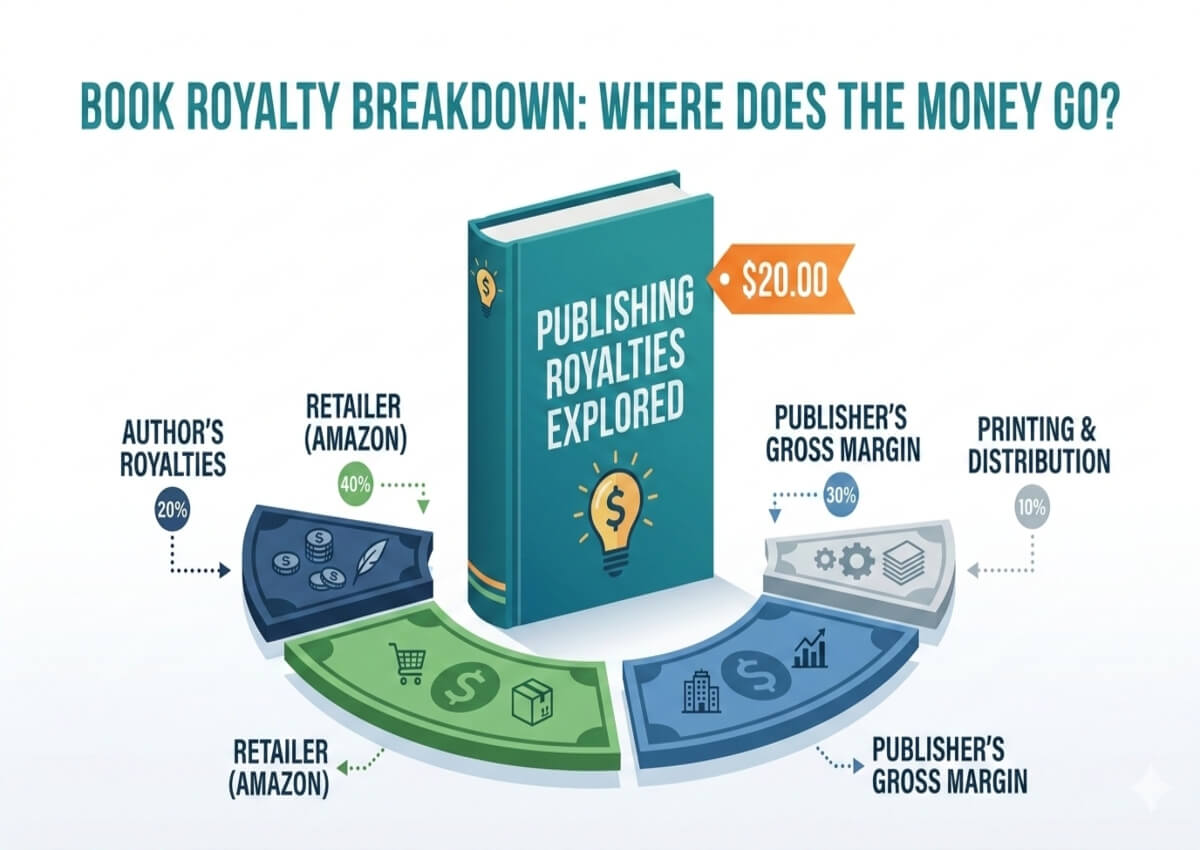
Where Does Your $20 Actually Go in a Traditional Deal?
When someone buys your traditionally published book for $20, here’s how that money gets divided:
| Party | Cut | Amount on a $20 Book |
| Retailer (Amazon, Barnes & Noble, etc.)Publisher (editing, printing, marketing) | 40 to 50% 30 to 35% | $8.00 to $10.00 $6.00 to $7.00 |
| Author gross royalty (10 to 15%) | 10 to 15% | $2.00 to $3.00 |
| Agent fee (15% of author’s cut) | ~1.5% | $0.30 to $0.45 |
| Author’s net royalty | ~8.5 to 13% | $1.70 to $2.55 |
And this is before factoring in your advance. If your publisher gave you $15,000 upfront, you won’t see a single royalty check until sales earn back that full amount. Many debut books never reach that point.
The Advanced Problem Nobody Talks About
Most authors celebrate getting an advance. And it makes sense to. But here’s the part that stings: you don’t earn royalties until the advance is fully recouped. If you received $10,000 and each sale earns you $2.00, you’d need 5,000 copies sold just to start seeing royalty payments.
According to The Write Practice’s royalty data, the average traditionally published book sells around 3,000 copies. At $2.00 per book, that’s $6,000 in total royalties, well short of even a modest advance. The advance becomes the only money many authors ever see from a book.
If you’re thinking about using AI to speed up your writing process while keeping full rights, it’s worth reading whether you can publish a book written with ChatGPT. There are some important platform rules and legal considerations to understand before you go that route.
Expanded Distribution: A Hidden Royalty Cut Worth Knowing
Opting into KDP’s Expanded Distribution sounds like a good idea. Your book shows up on Barnes & Noble, Bookshop.org, and independent bookstore systems. But it comes with a cost: your royalty rate drops from 60% to 40%.
For a $20 book with a 300-page print cost of $4.60, here’s what that looks like:
Expanded Distribution Royalty = ($20.00 x 0.40) minus $4.60 = $8.00 minus $4.60 = $3.40 per sale
That’s less than half of your standard Amazon royalty. For most self-published authors, expanded distribution doesn’t generate enough additional sales volume to compensate for the cut. Unless you’re actively pushing into physical retail, it’s often better to skip it. Source: Kindlepreneur KDP Royalty Calculator
What Do Real Authors Actually Earn on a $20 Book?
Formulas are helpful. Real-world data is better.
According to WordsRated, 54% of full-time authors earned under $12,488 from writing in 2017. Another 23% earned nothing from their books that year. Those numbers are sobering.
But the self-publishing side has been improving. PublishDrive’s analysis of author earnings shows the average self-publishing author earned around $12,800 from books, reflecting a 76% income increase since 2018, driven largely by KDP and direct sales platforms.
Here’s a practical look at what monthly earnings could look like on a $20 KDP paperback with a $7.40 royalty per sale:
| Monthly Sales | Royalty per Sale | Monthly Earnings | Annual Earnings |
| 50 copies | $7.40 | $370 | $4,440 |
| 100 copies | $7.40 | $740 | $8,880 |
| 200 copies | $7.40 | $1,480 | $17,760 |
| 500 copies | $7.40 | $3,700 | $44,400 |
| 1000 copies | $7.40 | $7,400 | $88,800 |
Based on a 300-page KDP paperback at $20 with a $4.60 printing cost and a 60% royalty rate. Figures for illustration.
Those numbers aren’t guaranteed, but they show what’s possible when a book finds its audience and maintains consistent sales.
Five Factors That Change How Much You Earn on a $20 Book
Royalty rates aren’t the whole story. Several other things affect your actual take-home per copy.
1. Page Count and Trim Size
Every page adds to your print cost. Going from 150 pages to 400 pages costs an extra $3.00 per copy in printing alone. If you’re writing nonfiction, tighter editing and cleaner formatting can shave 30 to 50 pages without cutting any real content. The 6×9 inch trim size is the most cost-efficient option available on KDP.
Source: KDP Official Paperback Printing Cost Page
2. Color vs. Black-and-White Interior
Color printing on KDP runs roughly $0.06 to $0.07 per page, compared to $0.012 for black and white. On a 200-page book, that’s $12.00 in print costs versus $3.40. Unless your book genuinely requires full-color images, black-and-white printing is the clear financial choice.
Source: BookBloom KDP Print Cost Guide
3. Which Distribution Channel You Choose
Standard Amazon-only distribution keeps your royalty rate at 60%. Expanded distribution drops it to 40%. The difference per sale is significant, and most authors don’t see enough extra volume from expanded channels to make up for it.
4. Your Tax Setup
Authors outside the US need to pay attention to tax withholding. Without a completed W-8BEN form, Amazon may withhold up to 30% of your royalties before they reach your account. This isn’t a small detail. Filing the right paperwork is one of the most overlooked steps in self-publishing.
5. Which Amazon Marketplace You’re Selling On
Selling on Amazon.com (USD) is different from Amazon.co.uk (GBP) or Amazon.de (EUR). Print costs vary by marketplace, and currency exchange rates take a small slice of international earnings. UK printing, for example, runs approximately £0.85 fixed plus £0.010 per page, according to HMD Publishing’s updated calculator.
Paperback vs. eBook at $20: Which One Earns More?
Both formats have trade-offs. Here’s a straight comparison:
| Format | Price | Royalty Rate | Print Cost | Author Earns | Best For |
| Paperback (300 pg, B&W) | $20.00 | 60% | $4.60 | $7.40 | Nonfiction, gifts, shelf presence |
| eBook at $20 | $20.00 | 35% | None | $7.00 | Rarely worth it at this price |
| eBook at $9.99 | $9.99 | 70% | ~$0.07 fee | $6.92 | Fiction, digital readers |
The takeaway here is interesting. A $20 paperback ($7.40) actually outearns a $20 ebook ($7.00), and it’s easier to justify the price because physical books have a higher perceived value. The $9.99 ebook lands almost exactly where the paperback does in earnings, but it converts better at that price point.
Source: Daniel J. Tortora, Self-Publishing Royalties 2026
Kindle Unlimited: Another Way to Earn From Your Book
Enrolling in KDP Select adds another income stream. Instead of selling copies, readers borrow your book through Kindle Unlimited, and you earn based on pages actually read, not purchases.
The rate fluctuates monthly based on Amazon’s global fund. In 2024 and into 2025, the rate has averaged around:
Average KENP rate: $0.0045 to $0.0048 per page read.
A 300-page book fully read earns roughly $1.35 to $1.44 per complete read.
That’s lower than a direct sale. But for books that attract heavy readership, the page-read volume adds up. A book generating 10,000 pages read per month earns around $45. Modest on its own, but layered on top of direct sales, it becomes a real secondary income stream.
The trade-off is 90-day exclusivity to Amazon. During that window, you can’t distribute your ebook through Apple Books, Kobo, or Google Play. If those platforms are important to your audience, KDP Select may not be the right call.
Source: KDP Sentinel Royalty Calculator
How to Maximize Your Author Earnings on a $20 Book
The royalty formula is fixed. But there are still several levers you can pull to earn more per book sold.
Test Your Price Every 90 Days
Don’t assume $20 is your best price. A book at $14.99 selling 150 copies a month earns more than a $20 book moving 50 copies. Use Kindlepreneur’s free KDP royalty calculator to model different price-volume combinations before locking anything in.
Trim Pages Without Cutting Content
Formatting choices have a direct financial impact. A 12pt font, standard 1-inch margins, and no unnecessary blank pages can remove 30 to 50 pages from a typical book. That reduction cuts your printing cost and puts more of each sale in your pocket.
Skip Color Interior Unless You Need It
Color printing costs roughly five times more per page than black and white. For authors who want charts, graphs, or illustrations, consider grayscale versions or directing readers to a supplementary website. Your per-copy margin will reflect the decision.
Sell Directly When You Can
Platforms like Payhip, Gumroad, or your own author site let you sell digital books with fees as low as 2 to 5%. On a $20 ebook sold directly, you could keep $17 to $19. That’s more than double the $7.00 you’d earn through Amazon. Direct sales take more marketing effort, but even a small volume sold this way can noticeably improve your overall earnings.
Stack Multiple Revenue Streams
The authors earning real, consistent income from books rarely rely on royalties alone. Audiobook rights, foreign translation deals, speaking engagements, online courses, and Kindle Unlimited layering all add revenue on top of your base sales. According to Publishing Push’s royalty breakdown, writers who treat their book as a platform rather than just a product consistently out-earn those who don’t.
Free Royalty Calculators Worth Bookmarking
Before you set your book’s price, run the actual numbers. These tools make it easy:
- Amazon KDP Official Royalty and Printing Calculator — The most accurate source for your exact print costs and royalties.
- Kindlepreneur KDP Royalty Calculator — Great for comparing paperback and ebook earnings side by side.
- HMD Publishing Royalty Calculator (2025 Updated) — Covers KDP, IngramSpark, and Apple Books across multiple marketplaces.
- BookBeam KDP Calculator — Clean interface with international marketplace breakdowns.
- The Write Practice Book Royalty Calculator — Useful specifically for traditional publishing estimates.
So, How Much Does an Author Make on a $20 Book?
Here’s the plain-English summary:
- Self-publish on KDP: You’ll earn roughly $6.20 to $9.20 per copy, depending on page count. A 300-page book earns about $7.40 per sale.
- Traditional publishing: You’ll earn around $1.70 to $2.55 per copy after your agent’s fee, and only after you’ve earned out your advance.
- eBook at $20 on KDP: You earn $7.00, but the 35% tier hurts conversion. Pricing at $9.99 earns nearly the same and typically sells far more copies.
Self-publishing through KDP puts significantly more money per copy in your hands. The trade-off is that you carry all the marketing weight yourself. No publisher is pushing your book into store windows or booking your reviews.
But the financial control is real. You set the price, you choose the distribution, and you keep the lion’s share of every sale.
For authors using modern tools to write and publish faster, it’s worth understanding the full picture. Whether you’re writing solo or with AI assistance, the royalty math stays the same. And that math, as we’ve walked through above, clearly favors self-publishing royalties on a $20 paperback over most traditional arrangements.
Bottom line: A $20 self-published KDP paperback (300 pages, black and white) puts approximately $7.40 in your pocket per sale. A traditionally published $20 book puts closer to $1.70 to $2.55. The difference compounds quickly at any meaningful sales volume.
Disclaimer: Royalty rates and printing costs can change. Always verify current figures using Amazon KDP’s official tools before finalizing your pricing strategy.
Leave a Reply